
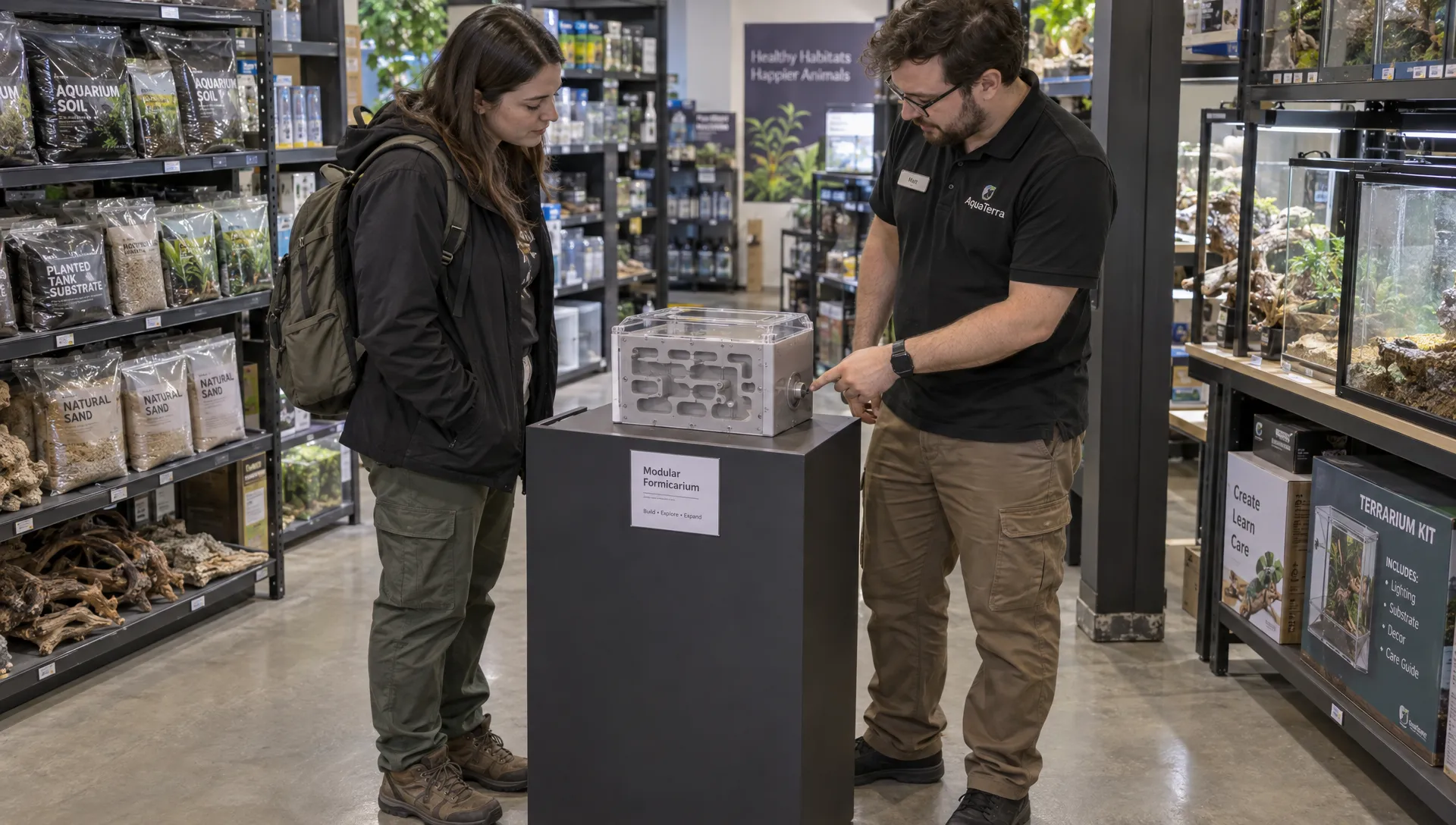
A 3d printed formicarium can offer useful features, including removable chambers, custom connection ports and compact layouts. But a neat print and a clear lid do not tell you whether it will safely house your ants. Material additives, small gaps, unreliable hydration and chambers that are too large can all create problems after a colony moves in.
The safest choice is a nest whose materials, assembly and moisture system you can assess before introducing ants. Start with your species and current colony size, then check the design against the practical requirements below.
Look beyond the filament name
Most filament-printed nests are made by depositing successive layers of plastic. The finished part depends on more than the base polymer: pigments, fillers, printing quality and any subsequent treatments also matter.
Common materials have different limitations. None of the names in this table is, by itself, evidence that a finished nest is suitable for ants.
| Material | Practical consideration | What to check before buying |
|---|---|---|
| PLA | Easy to print but susceptible to deformation under heat | Placement restrictions, cleaning instructions and compatibility with any proposed heating |
| PETG | Generally offers better heat resistance than standard PLA | Exact filament, print quality and sealing around wet areas |
| ABS or ASA | Can produce durable parts but requires appropriate printing conditions | Finished-part quality, additives and any surface treatment |
| Photopolymer resin | Requires thorough washing and curing after printing | Documented suitability of the finished material for prolonged contact with ants and moisture |
For a 3d printed formicarium, ask which exact filament or resin was used, not simply whether the material is “non-toxic”. A food-contact claim does not establish suitability for ants living against the surface continuously.
Avoid unknown recycled blends, antimicrobial additives, decorative coatings and exposed adhesives unless the maker can explain their suitability. Wood-filled filament should not be assumed safer because it contains wood. Persistent odour, tackiness or powdery residue are reasons to postpone use, although their absence does not prove safety.
Resin printing deserves particular caution. An attractive, dry-looking part is not proof of complete washing, curing or suitability for a living nest.
Match chamber dimensions to the colony you have
A large nest is not automatically a better purchase. Excess unused space can become a dumping area for food and waste, especially when the colony has little reason to keep those chambers clean.
Ask for usable chamber dimensions rather than the enclosure’s outside measurements. Check whether the queen can turn comfortably, whether workers can carry brood through connecting passages and whether smaller workers could disappear into unintended cavities.
Your species matters more than a generic capacity label such as “holds 500 ants”. Worker size, queen size, brood volume and nesting behaviour differ considerably between species.
Choose a 3d printed formicarium with an initially accessible area appropriate to the present colony, rather than opening every chamber in anticipation of growth. Expansion sections are useful only when unused areas can be securely isolated without creating hidden escape routes.
For a founding queen or a very small colony, a properly prepared test tube nest may remain the more manageable option. There is no need to move ants simply because a display nest is available.
Inspect joints, ports and the viewing cover
Escape resistance depends on the smallest workers, not the queen or the most noticeable ants. Look closely at the complete route between the chamber and the room, including spaces beneath the viewing cover.
A lid that sits flat when empty may lift slightly when a connector is inserted or a screw is tightened unevenly. Printed parts can also warp, leaving a gap that is difficult to see from above.
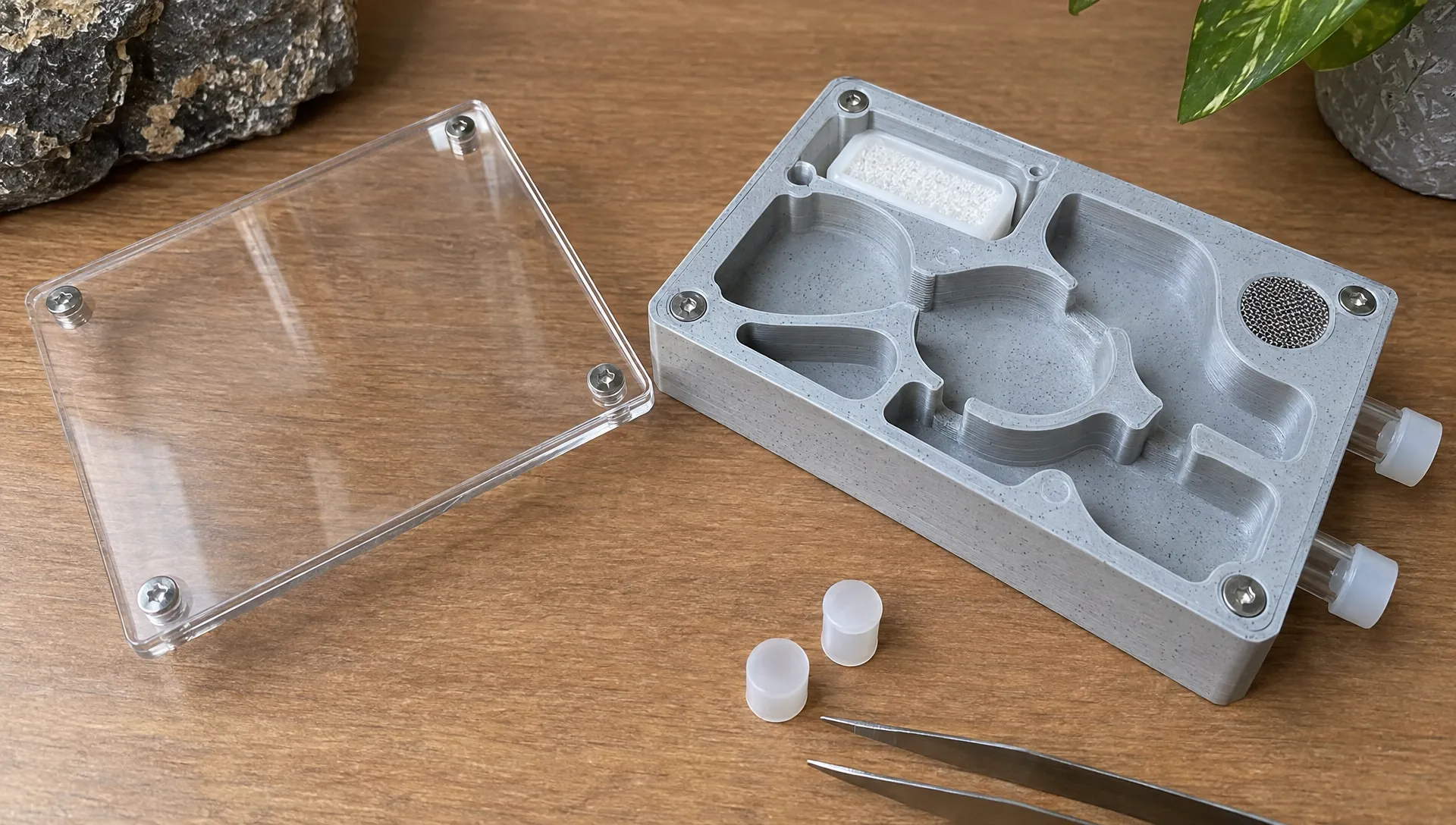
Before accepting a 3d printed formicarium, inspect it under bright light and check the following points:
- Viewing cover: It should sit evenly, with secure fasteners and no lifted corners.
- Connection ports: Tubing and plugs should fit firmly without splitting or distorting the surrounding plastic.
- Ventilation: Mesh must suit the smallest workers and be secured around its full perimeter.
- Layer surfaces: Reject cracks, separated layers, loose strands or sharp projections inside accessible chambers.
- Hidden spaces: Ants should not be able to enter hollow walls, screw channels or spaces beneath inserts.
Ask how individual parts are removed and refitted. A nest that seals only after delicate adjustment may become difficult to service safely once occupied.
An outworld barrier can provide secondary protection where appropriate, but it does not repair a poor nest seal. Never test a questionable gap by releasing ants into the enclosure and waiting to see whether they escape.
Can a 3d printed formicarium manage moisture reliably?
Printed plastic usually functions as a shell, not as a controlled moisture-distributing material. A water reservoir beside a chamber does not necessarily provide the conditions that species needs.
Look for a clearly explained hydration system. This might use a suitable porous insert, a wick or another mechanism designed to transfer moisture without exposing ants to open water. Ask which areas become damp, which remain drier and whether workers can reach or damage the water-delivery components.
A useful arrangement gives ants access to a moisture gradient rather than making every chamber equally wet. Species requirements differ, so there is no single humidity percentage or watering schedule that makes every design safe.
Watch for flooding around reservoir connections and persistent condensation on the viewing surface. Condensation can reflect temperature differences as well as excess moisture, so assess the whole setup rather than treating droplets as a humidity gauge.
Also check ventilation before choosing a 3d printed formicarium. Large vents can make a small nest dry quickly, while restricted airflow can leave wet areas slow to dry. Neither more ventilation nor more water is automatically better.
Any insert should fit closely enough to prevent ants entering behind it. It should also remain stable through wetting and drying. Ask whether replacement parts are available and how the insert is serviced without exposing the colony.
Run the complete nest empty before use
An empty trial cannot certify chemical safety or guarantee escape resistance, but it can reveal practical faults before ants are involved. Assemble the nest with its intended cover, tubing, plugs and hydration components, then place it where it will actually be kept.
Follow the maker’s filling instructions and observe at least one full watering-and-drying cycle. A quick overnight check may miss slow leaks or unexpectedly rapid drying. Check underneath the nest as well as inside the chambers.
During this trial, a 3d printed formicarium should hold its shape, keep connections secure and deliver water without pooling in living areas. Record how much water you add and how conditions change. This gives you a starting point for maintenance, not a permanent watering schedule.
Keep it away from direct sunlight, radiators and other uncontrolled heat sources. If the species needs supplemental heating, confirm that the complete design supports it and use appropriate temperature control. A heat-tolerant filament does not make an unregulated heater safe.
Check access for cleaning and feeding too. You should be able to service the outworld without dismantling the nest or disturbing the queen’s chamber. Refit removable parts several times while the enclosure is empty to confirm that their alignment remains reliable.
Buying a finished nest versus printing your own
A downloadable STL file describes geometry. It does not prove that a model has been tested with your species, that the printed surfaces will seal or that a particular filament is suitable.
When buying a finished nest, request photographs of the actual product, including the underside, port connections and hydration components. Useful instructions should explain assembly, filling, cleaning and limitations. “Ant-safe” without supporting detail tells you little.
When making a 3d printed formicarium yourself, inspect the finished object rather than relying on the preview in your slicer. Layer height, extrusion consistency, print orientation and dimensional accuracy can all affect fit. Increasing infill does not automatically make a reservoir watertight or eliminate tiny gaps around a lid.
Keep printing, sanding and resin-processing work away from occupied ant habitats. Remove loose debris before assembly and avoid improvised sealants or solvent treatments inside chambers. A repair that closes a leak may introduce a different material-exposure problem.
For expandable designs, standardise the connection system before adding sections. Our guide to choosing a modular formicarium explains how to plan growth without opening unnecessary space from the start.
Plan the move before connecting the colony
A nest can pass its empty checks and still be unsuitable for an immediate move. Confirm that the colony is large enough, that the moisture system is functioning and that the connection route is secure.
Where practical, connect the existing nest to the new enclosure and allow the ants to relocate voluntarily. Provide suitable conditions in the destination while keeping a safe water source available. Do not flood, overheat or dangerously dry the old nest to force movement.
Moving into a 3d printed formicarium is not something to rush because the ants hesitate for a few hours. They may continue using their existing nest, explore the new chambers gradually or move brood in stages.
Once the setup is secure, reduce disturbance. If you tend to lift the cover every few minutes, choose a quiet distraction, such as reading or a word puzzle with an optional Wordle solver, rather than repeatedly interrupting the colony.
Keep the old nest connected until relocation is complete and you have checked for remaining ants or brood. After occupation, monitor water delivery, connections and waste accumulation. Empty testing helps, but the colony’s use of the space may reveal maintenance issues you could not assess beforehand.
Questions to ask before you buy
A seller should be able to explain the exact material, accessible chamber dimensions, smallest suitable worker size and hydration method. Ask how ports are sealed, which components are replaceable and what cleaning products or temperatures the maker permits.
Choose a 3d printed formicarium only when those answers fit your colony and your maintenance routine. If a listing offers attractive photographs but no information about moisture delivery or secure assembly, request details before ordering.
You do not need the most elaborate design. A modest nest with clear instructions, dependable connections and an understandable water system is easier to assess than one with inaccessible reservoirs and decorative cavities.
Frequently asked questions
Is PLA always safe for ants? No. PLA identifies the base polymer, not every pigment, additive or treatment in the finished part. Assess the exact material, construction and intended use. Also account for PLA’s sensitivity to heat when choosing placement and cleaning methods.
Does 100% infill make a printed nest waterproof? Not necessarily. Leakage can occur through imperfect layer bonding, seams and connections. Test the assembled hydration system empty rather than relying on an infill setting or a short water test.
Can I disinfect a printed nest with boiling water? Do not assume so. Heat can deform printed parts, changing the fit of covers and ports. Follow instructions for the exact material and components. If the maker cannot provide a suitable cleaning method, consider that a maintenance limitation before buying.
When should I replace a printed nest? Reassess it if you find cracks, warping, loose mesh, damaged hydration components or connections that no longer fit securely. Arrange a controlled transfer to a suitable enclosure rather than attempting an uncertain repair around an occupied colony.
Choose the enclosure around your ants
The right 3d printed formicarium is one you can inspect, hydrate, clean and secure for the species you actually keep. Appearance and expandability come after those requirements.
If you are unsure which nest type fits your colony, ask Ant Farms Calgary for a kit recommendation. Share the species, approximate worker count and current setup so the discussion starts with the ants’ needs rather than the enclosure’s appearance.



Leave a comment