Finding a leafcutter ant queen for sale is only the first step. These ants depend on a living fungal garden, so buying them means taking responsibility for both an insect colony and its food-growing system. A queen in a tube is not equivalent to a ready-to-keep leafcutter colony.
Before paying, establish exactly what is included, whether the shipment is permitted and how you will maintain the colony through a Canadian winter. The equipment and ongoing work can matter much more than the purchase price.
Start with the scientific name
“Leafcutter” describes several species, not one standard pet. Ants sold under this name commonly belong to Atta or Acromyrmex, and their founding behaviour, environmental needs and eventual colony size differ.
Some Atta species can develop exceptionally large colonies. An Acromyrmex colony may be more manageable by comparison, but that does not make every species suitable for a small desktop setup.
Ask for the full scientific name, the colony’s origin and a care plan specific to that species. If the seller cannot identify the ants beyond “tropical leafcutters”, you cannot reliably assess their housing needs or the rules applying to their movement.
A leafcutter ant queen for sale is not always a starter colony
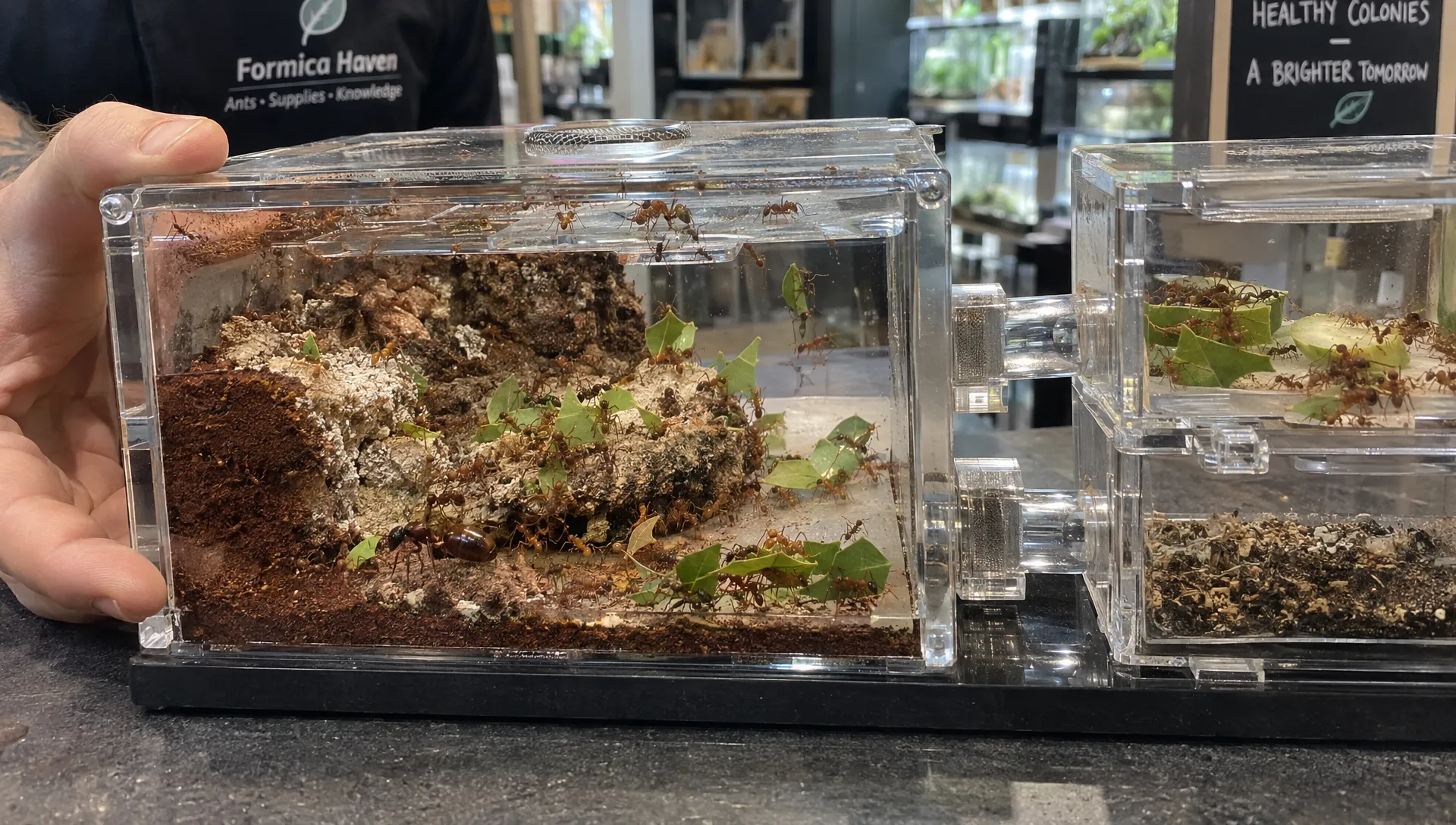
The queen is only part of the biological package. Leafcutters cultivate a specialised fungus on collected plant material. That garden is central to colony nutrition, particularly for developing brood.
A founding queen may carry a tiny fungal inoculum, but a photograph of the queen alone cannot establish that she will successfully start a garden. Founding methods also differ between species.
| Listing type | What needs verification | Main concern |
|---|---|---|
| Newly mated queen only | Species, collection history and founding requirements | Mating and successful fungus establishment may be unproven |
| Queen with workers and fungus | Current queen condition, worker population and garden condition | An established colony still needs careful transport and acclimation |
| Queen and workers without confirmed fungus | Whether viable fungus is actually included | Workers do not replace the colony’s fungal food system |
An established colony with a functioning garden provides more evidence of successful founding than a queen-only listing, though it does not eliminate risk. Ask for recent images of the actual colony rather than representative stock photographs.
Verify Canadian availability and shipping permission separately
A leafcutter ant queen for sale overseas is not necessarily eligible for import into Canada. Likewise, a retailer’s general “ships to Canada” statement does not establish permission to send a particular ant species, its fungus or its substrate.
No current Canadian leafcutter stock or approved shipping route is confirmed by this guide. Availability must be checked directly with the seller, and legal eligibility must be checked independently.
For an international purchase, contact the Canadian Food Inspection Agency with the scientific name, country of origin, destination province and details of the fungal culture and packing material. Consult its Automated Import Reference System, then request clarification if the exact situation is unclear. Ask whether permits, inspections or other conditions apply before arranging payment or dispatch.
Domestic purchases deserve checks too. Confirm any applicable provincial restrictions and whether moving the ants, fungus or associated material between provinces is permitted. An Ontario address, for example, is not covered merely because a seller advertises nationwide delivery.
Keep written answers and any required documentation. Export paperwork from the seller’s country does not, by itself, establish Canadian import permission. Never release unwanted ants or their garden material outdoors.
Prove that you can maintain the fungal microclimate
Before responding to a “leafcutter ant queen for sale” listing, obtain the species-specific temperature and moisture requirements in writing. A single humidity figure copied from another species is not an adequate care plan.
The fungus chamber needs a stable microclimate without becoming waterlogged or stagnant. Room humidity, chamber humidity and moisture within the garden are related, but they are not interchangeable measurements. Condensation alone does not prove that conditions are suitable.
Use a controlled heat source where the species requires one, with a thermostat and an independent temperature check. Ask where probes should be positioned without disturbing the garden. Avoid direct sunlight, unregulated heating and arrangements that can overheat a sealed chamber.
Run the empty installation before the ants arrive. Check daytime and overnight conditions, including what happens when the room heating changes. Plan how you will respond to equipment failure rather than discovering the limits during a cold snap.
Canadian winter care involves more than warmth. Indoor heating can dry enclosures, while outages can cool them rapidly. A backup plan should address both problems. Do not spray the fungal garden directly or change ventilation abruptly unless the species-specific care protocol calls for it.
Budget for containment, expansion and waste handling
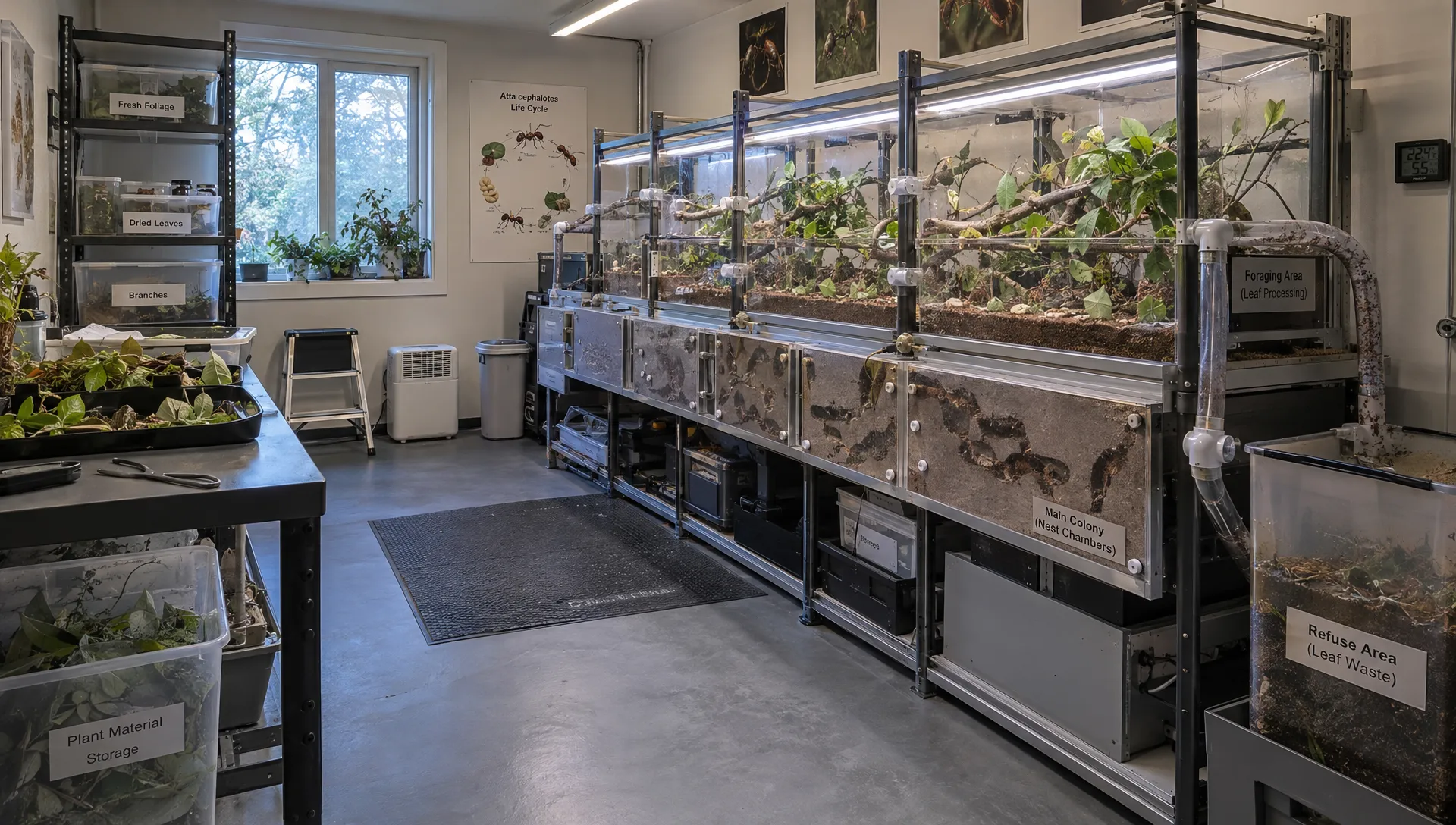
Price a complete installation before choosing a leafcutter ant queen for sale. The nest chamber is only one component: you also need appropriate foraging space, secure connections and a practical way to remove waste.
A workable design separates the fungal garden from feeding and refuse areas. It should let you replace plant material, remove discarded substrate and inspect connections without repeatedly opening the garden chamber.
Check the smallest workers against every ventilation opening and connection. Lids, cable entries and tubing joints need attention, not just the main enclosure walls. Use containment measures appropriate to the species and maintain them as instructed; a barrier is not a substitute for a secure lid.
Expansion should be planned before crowding develops. Ask how additional chambers can be connected without forcing a disruptive move, and where the installation will fit as it grows.
For a large custom exhibit that genuinely requires machined shafts or rollers, Jakom’s specialist component manufacturing addresses that mechanical work. Ant containment and animal-safe materials still require separate assessment. Most home keepers should not need industrial fabrication.
Choose equipment that you can service safely yourself. A complicated display loses its appeal quickly if routine cleaning requires dismantling the colony’s main habitat.
Secure a year-round supply of suitable plant material
A leafcutter ant queen for sale may look affordable until you account for feeding a growing fungal garden throughout the year. Summer access to garden leaves is not a winter supply plan.
The ants process accepted plant material as substrate for their fungus. Species and individual colonies differ in what they accept, so ask the seller what this particular colony is currently using. Arrange a dependable source before delivery.
Use correctly identified plants with a known treatment history. Roadside clippings, florist foliage and recently purchased ornamental plants can introduce contamination or pesticide exposure. Washing does not reliably remove systemic pesticides within plant tissue.
Do not assume that every untreated plant is suitable, or that frozen and dried leaves will replace fresh material successfully. Confirm any storage method against the colony’s established feeding routine.
Offer manageable amounts and remove rejected material before it deteriorates. Watch what the ants incorporate into the garden, not simply what they carry through the entrance. Changes in cutting or collection deserve investigation alongside temperature, moisture and garden condition.
Waste handling needs its own tools and disposal routine. Keep refuse contained and avoid transferring it back into the feeding or fungus areas.
Ask the seller for evidence, not reassurance
A useful seller can explain the condition of the specific colony and the limits of their shipping arrangements. “Easy care” and “healthy queen” are not substitutes for documentation.
Before paying, request these details:
- Actual colony evidence: Recent photographs or a live viewing showing the queen, workers, brood where visible and fungal garden.
- Colony history: How long the seller has kept it, its approximate worker population and whether it has recently been moved or divided.
- Garden baseline: What healthy growth looks like for this colony, what it currently accepts and which changes should prompt concern.
- Shipping plan: Packaging, weather limits, expected transit time and what happens if dispatch must be postponed.
- Arrival terms: Whether the guarantee covers the queen, workers and viable fungus, plus reporting deadlines and required evidence.
- After-sale support: Who can answer species-specific questions if the garden declines after arrival.
Shed wings alone do not prove that a queen is successfully mated, and photographs cannot guarantee future performance. Look for several pieces of consistent evidence rather than one reassuring detail.
For broader purchase checks, our guide to what to verify before ordering an ant queen covers identity, founding evidence and destination suitability. Leafcutters add the fungal garden as another essential part of that assessment.
Match the commitment to your experience
A leafcutter ant queen for sale is a poor impulse purchase if you have never maintained an ant colony. You would be learning containment, colony behaviour and fungal husbandry at the same time.
Expect daily observation of environmental readings, feeding activity and waste accumulation. Necessary hands-on work varies with colony size and conditions, but the setup should not depend on someone noticing a problem only once a week. Repeatedly opening the garden to inspect it can also create disturbance, so build observation into the enclosure design.
Travel requires a trained caretaker who understands the system. Do not assume a general pet sitter or ant-boarding service accepts leafcutters; confirm that capability before relying on it.
For a first colony, a legally sourced, destination-appropriate Lasius neoniger queen offers a more manageable starting point without the need to cultivate a leafcutter fungal garden. You still need secure housing, suitable nutrition and a species-appropriate diapause plan.
The practical readiness test is whether you can already explain your response to a heater failure, rejected food, an escape or a deteriorating garden. If those answers depend entirely on asking the seller after something goes wrong, postpone the purchase.
Frequently asked questions
Where can I find a leafcutter ant queen for sale in Canada? Confirm current inventory directly with specialist sellers. A general live-ant catalogue does not establish leafcutter availability, and an active listing does not establish permission to ship to your province. Request the scientific name and shipment details before checking the applicable requirements.
Can leafcutters live in an ordinary ant farm starter kit? Not automatically. The setup must support the species’ fungal garden, moisture needs, ventilation and containment requirements. A kit intended for common beginner species should not be assumed suitable without a specific assessment.
Does a live-arrival guarantee protect the fungal garden? Only if the written terms say so. Ask how the seller defines acceptable garden condition, what evidence is required and what remedy applies. A guarantee covering only a living queen may leave a major part of the purchase unprotected.
Should I buy a queen-only listing to save money? Only if you understand that species’ founding process and accept the additional uncertainty. A lower purchase price does not compensate for missing fungal support, unsuitable equipment or unverified shipping permission.
Choose a colony you can support long term
Before buying a leafcutter ant queen for sale, resolve four essentials: legal eligibility, a viable fungal system, tested housing and dependable ongoing care. If any remains uncertain, wait.
Ant Farms Calgary offers live colonies, modular farms, starter kits and personalised kit recommendations. Ask about current stock and a setup suited to your experience. If leafcutters are your specific goal, confirm availability, destination eligibility and species-specific support explicitly rather than assuming that a general ant kit or shipping policy covers them.




Leave a comment