
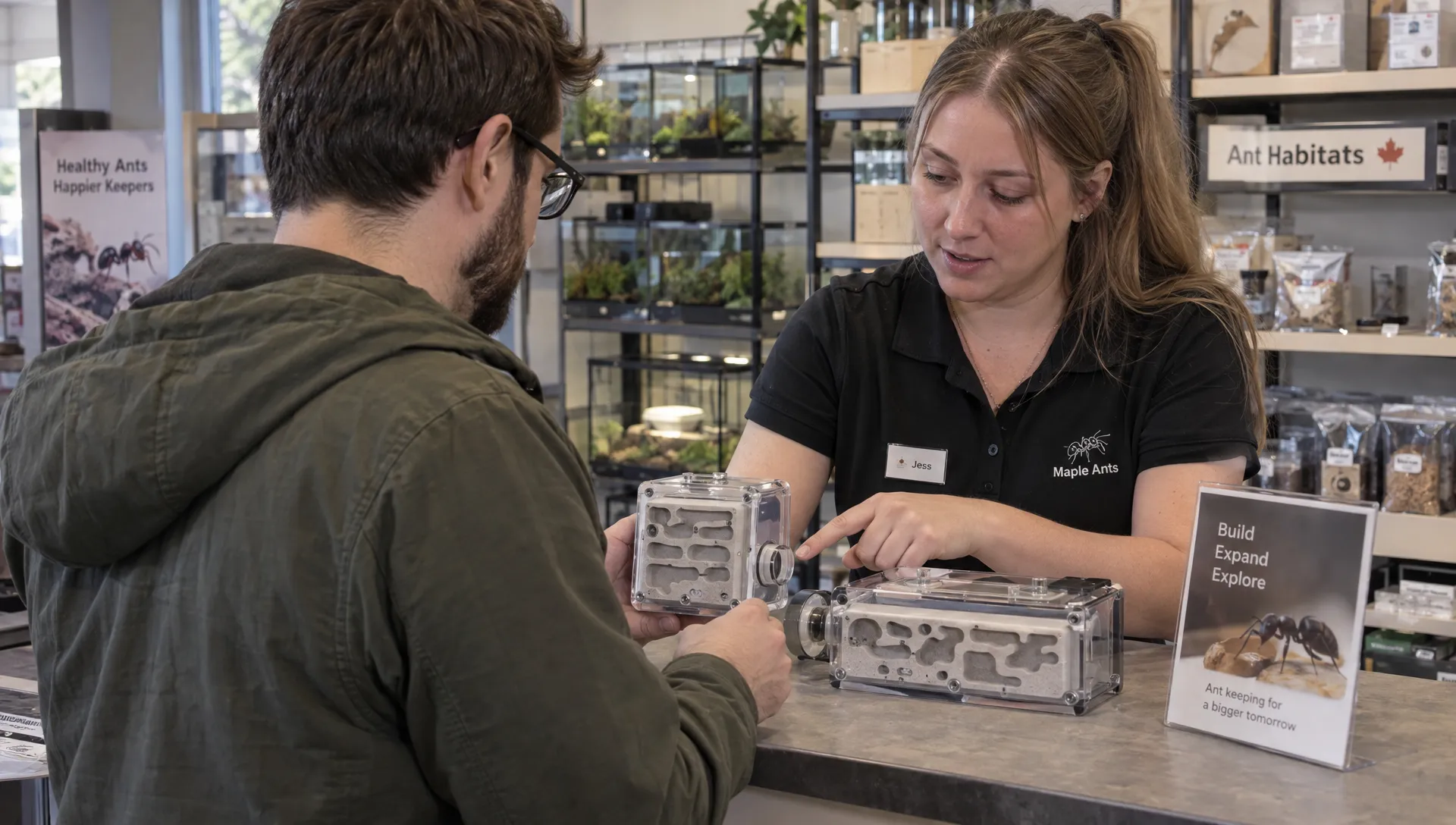
The best modular formicarium fits your colony today without forcing you to replace the whole setup later. That means more than having an extra connection port. You need suitable chamber dimensions, manageable hydration and a practical way to add space without giving ants an escape route.
Start with the species and colony stage, then compare expansion options. A small nest with useful connections is often a better purchase than a large enclosure whose extra chambers cannot be closed off.
Start with your ants, not the advertised capacity
An enclosure advertised for a certain number of ants offers only a rough guide. Small workers and large workers use space differently, while brood, food storage and colony behaviour also affect how much room is useful.
Check the size of the queen as well as the workers. Chamber height, entrance openings and connecting tubes must accommodate the largest ants that need to move through them. Conversely, tiny workers may escape through gaps that contain larger species successfully.
Colony stage matters just as much. Many young colonies can remain in an appropriate test-tube nest connected to a small feeding area rather than moving immediately into permanent chambers. Our guide to preparing test tubes for founding queens explains that starting arrangement.
Before comparing products, establish your species’ nesting requirements, current worker population and seasonal activity pattern. Those details are more useful than buying for an optimistic future population.
What should a modular formicarium let you expand?
Look for controlled expansion rather than simply maximum capacity. You should be able to add the kind of space the colony needs while keeping unused areas securely closed.
| Feature to compare | What to look for | Why it matters |
|---|---|---|
| Nesting space | Small initial chambers or sections that can be isolated | Avoids opening a large empty nest too early |
| Expansion ports | Documented dimensions and secure closures | Makes future connections easier to plan |
| Hydration | Accessible refill points and clear operating instructions | Lets you maintain moisture with less disturbance |
| Foraging area | Space for food, drinking water and waste removal | Keeps routine care practical as activity increases |
| Access | Reachable feeding areas and service points | Reduces the need to dismantle an occupied setup |
| Future modules | Available extensions with confirmed compatibility | Makes the expansion path realistic rather than theoretical |
Ask whether “modular” means additional nest sections, additional outworlds or both. Some systems connect complete enclosures with tubing; others use direct-fitting components. Neither approach is automatically better, but their space requirements and maintenance routines differ.
A modular formicarium is most useful when its smallest practical configuration suits your existing colony and its next expansion solves a clearly identifiable need.
Match chamber design and hydration to the species
Compare usable dimensions, not just the outer footprint
External measurements do not tell you how much suitable nesting space is inside. Check internal chamber height, passage width and how much of the module is actually available to the ants.
Deep chambers may offer poor visibility for small species, while shallow passages may be unsuitable for larger queens. Seed-harvesting species may also need dry storage areas alongside appropriate nesting moisture. Ask for species-specific recommendations rather than assuming one layout suits every colony.
Visibility should not come at the expense of shelter. Choose a design that allows the nesting area to remain covered and undisturbed between inspections.
Understand how water reaches the nest
A reservoir, gypsum insert, sponge or other hydration component needs clear instructions. Find out where water goes, how you check its level and whether refilling requires opening an occupied area.
Different materials manage moisture differently. Gypsum can absorb and distribute water, while acrylic chambers generally depend on a separate hydration arrangement. Neither material alone guarantees suitable conditions.
Look for a usable moisture gradient where the species needs one, rather than assuming the entire nest should be equally damp. Persistent condensation, standing water or frequently drying chambers deserve investigation.
Choose a modular formicarium whose hydration routine you can maintain reliably, including during dry Canadian winters when indoor heating can change evaporation rates.
Separate the need for nesting space from foraging space
A busy feeding area does not necessarily mean the nest is too small. Workers may need more room to collect food, access drinking water and deposit waste while their existing brood chambers remain adequate.
An outworld is the accessible activity area outside the nest. Expanding it can make feeding and cleaning easier without increasing the amount of enclosed nesting space the colony must occupy.
For example, Ant Farms Calgary’s outworld extension module is intended to add activity space to compatible modular farms. Confirm the connection requirements for your particular setup before ordering.
The reverse also applies: a spacious outworld does not solve overcrowded brood chambers. Watch where congestion occurs before deciding which component to add.
When evaluating a modular formicarium, treat nest expansion and outworld expansion as separate decisions. That distinction can save you from buying a larger nest when the real problem is an awkward feeding area.
Check every connection before committing to a system
Ask for measurements and compatibility confirmation
“Connects with tubing” is not a complete specification. You need the port dimensions, the required tubing dimensions and the method used to secure the joint. Inner and outer tubing diameters are different measurements, so a nominal size alone can be misleading.
Check whether adapters, plugs and connectors are included or purchased separately. Do not assume modules from different manufacturers will fit because their openings look similar in photographs.
Useful connections should also remain accessible once the enclosure is on its shelf. A rear-facing port pressed against a wall is difficult to inspect or use safely.
Plan how you will isolate an occupied module
Before ants move in, understand how you would close a port, disconnect a section or replace a damaged component. Secure isolation can make maintenance much easier, but do not assume a system includes gates or valves unless the seller confirms it.
Inspect lids, seams, ventilation openings and plugs for your species’ escape risks. A connection should not depend on a loose friction fit that shifts whenever you refill water or clean nearby.
If disconnection will be necessary, ask the seller how it should be performed with ants present. Improvised work on an occupied connection creates avoidable escape risks.
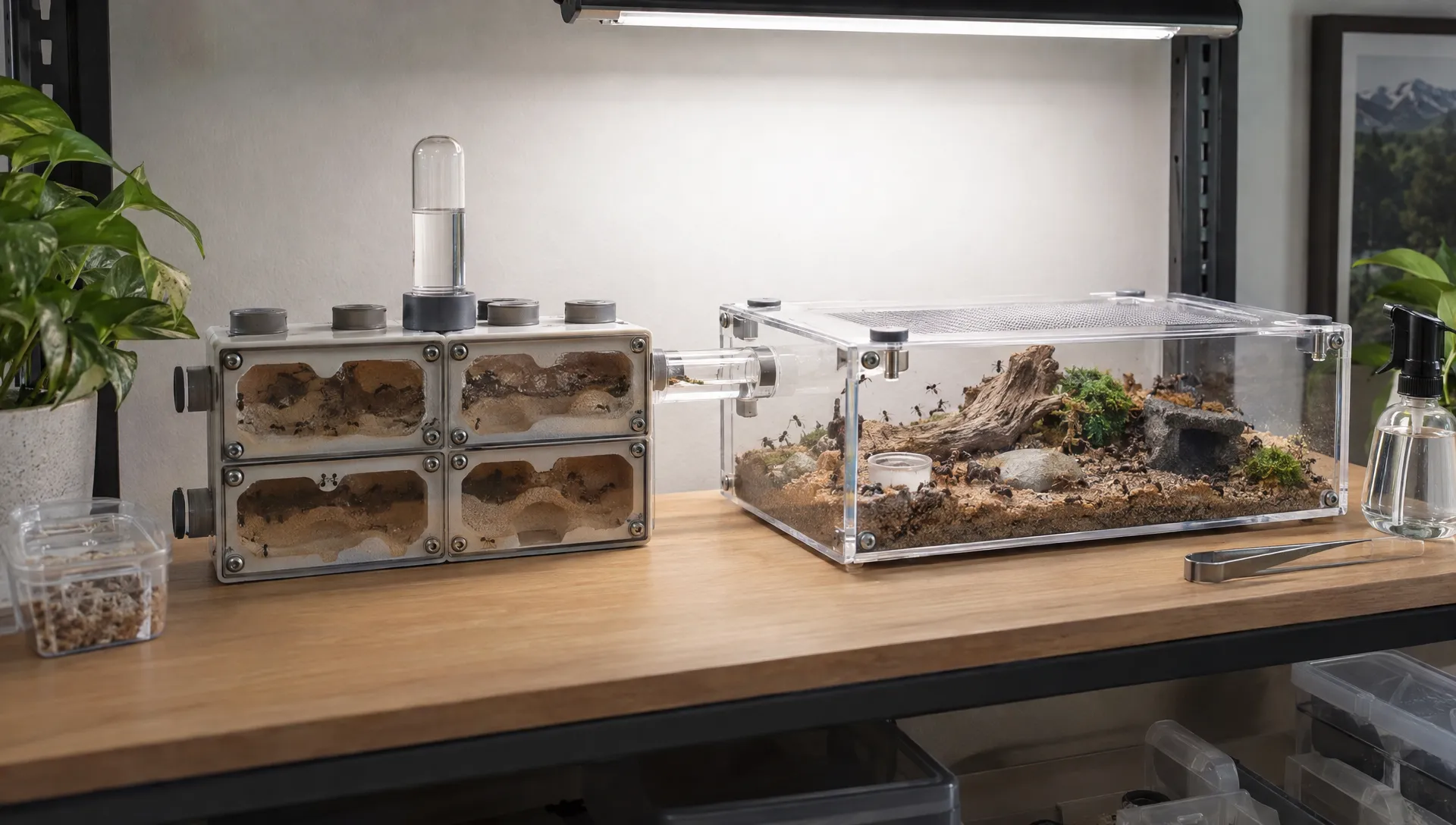
Reserve space for the expanded setup
Measure the complete future arrangement, not just the starter nest. Tubing bends, feeding access, covers and hydration points all need clearance. Vertical modules can reduce the footprint, but their height may make servicing difficult beneath a low shelf.
A stable surface also matters. Avoid locations where doors, drawers, pets or routine household activity will repeatedly knock the enclosure. Direct sunlight can heat a small enclosure unexpectedly, so choose the position for environmental stability rather than display value alone.
If your proposed display area also houses a sauna or hot tub, place the ants in a separate room where heat and steam will not disturb their conditions.
For a modular formicarium, leave enough working room to inspect connections and add the next component without moving the entire occupied system. Sketching the expanded footprint on paper is a simple way to check whether your chosen shelf will still work later.
Expand when the colony needs it, not on a calendar
There is no universal worker count or monthly schedule for adding chambers. Species, worker size, brood volume and seasonal activity all influence the decision.
Look for sustained patterns across several checks. Nest chambers may be consistently well occupied, brood may be crowded into limited suitable areas or access routes may remain congested. These observations are more useful together than any single busy afternoon.
Also rule out environmental problems. Ants gathering near an entrance or moving brood into the outworld could be responding to unsuitable moisture, heat or disturbance rather than insufficient floor space.
When expansion is justified, prepare and test the new module before connecting it. Check hydration, closures and joints while it is empty. Keep the established nest available while the colony explores, and avoid forcing relocation by flooding, overheating or drying out its existing home.
A modular formicarium should make gradual expansion possible, but the ants may not occupy a new section immediately. Unless there is a welfare concern requiring intervention, allow time for exploration and follow species-appropriate relocation advice.
If your species undergoes diapause, reduced activity is not a reason to add space. Consider its seasonal cycle before interpreting slower movement or growth as a housing problem.
Compare the starter kit with its next two upgrades
Before buying, price a realistic sequence: the initial setup, the next useful expansion and the fittings required to connect them. Include shipping where applicable. A low starter price is less attractive if the next step requires replacing much of the enclosure.
For a concrete comparison, review a complete option such as the Modular Farm 3XV starter kit, then ask which extensions suit your colony and what additional connection parts they require. Do not treat the kit name or chamber count as a species recommendation.
Before checkout, get clear answers to these questions:
- Which species and colony stages suit the smallest usable nesting area?
- Can unused chambers and ports remain securely closed?
- Which currently available extensions fit this exact model?
- What parts are needed to connect, isolate and hydrate those extensions?
- Can routine feeding and cleaning be done without opening the nest?
Keep the answers with your setup notes. They become especially useful when ordering another component months later.
Frequently asked questions
Can a founding queen go straight into a large nest? Usually, choosing a large nest simply to avoid later upgrades is not the best starting point. Many commonly kept species begin in suitable test-tube setups, although founding requirements vary. Match the arrangement to the species and stage rather than the colony size you hope to reach.
Can I connect modules from different brands? Sometimes, but only after confirming dimensions, materials and a secure connection method. A modular formicarium is not necessarily built around a universal standard. Obtain compatibility advice before buying mixed components.
Does an empty chamber always cause mould? No. Mould depends on moisture, organic material and other conditions. However, unused chambers can become places where ants leave waste that is difficult to remove. Restricting access to unnecessary space can make management easier.
Should I add a nest module or an outworld first? Add the space that addresses the actual constraint. Crowded brood chambers suggest a nesting-space issue; difficult feeding access or an overloaded waste area may justify a larger outworld. Check environmental conditions before assuming either is too small.
Choose a setup with a clear next step
The right purchase gives your ants suitable space now and gives you a manageable route to expand later. Prioritize species fit, reliable hydration and secure connections over maximum advertised capacity.
Ant Farms Calgary offers modular farms, starter kits and personalized kit recommendations. Share your species, approximate worker count, current housing and available shelf space through WhatsApp or email support to get advice on a suitable starting configuration and its next expansion.




Leave a comment