An acrylic formicarium can be a good home for your ants, but clear walls alone tell you very little about whether it suits their species. The deciding factors are how the nest supplies moisture, whether its chambers fit the ants and how securely it contains the smallest workers. A setup that works for one colony may dry out too quickly or offer unsuitable nesting space for another.
Before buying, separate the material you can see from the conditions your ants will actually experience. That distinction matters more than the product’s appearance.
Start with the nesting surface, not the clear walls
Some habitats use stacked acrylic sheets to form the nest itself. Others have an acrylic enclosure around gypsum, clay, sand or another nesting material. Both can look like “acrylic ant farms” in a product photograph, but they manage water differently.
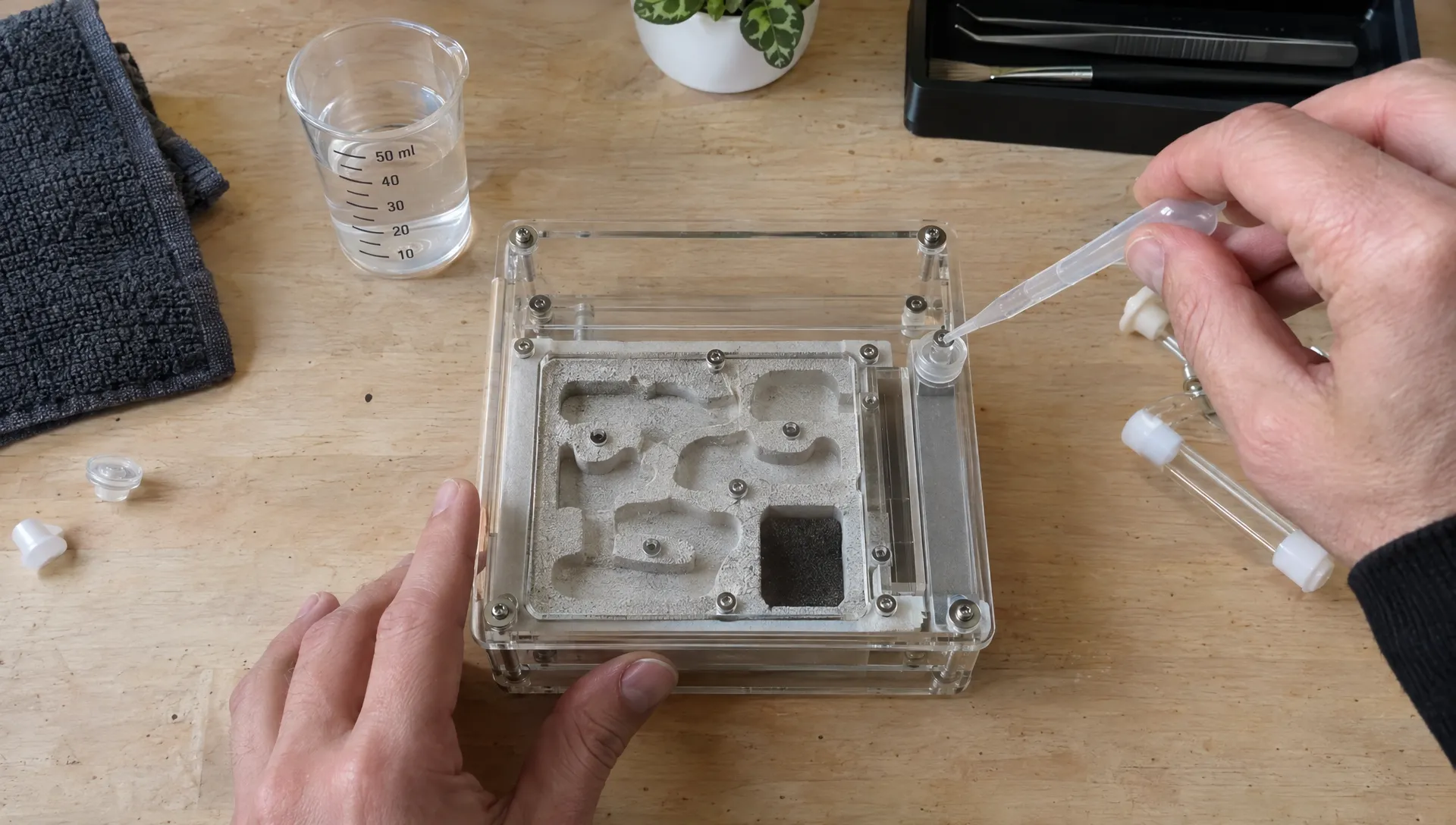
Acrylic is non-porous. Unlike an absorbent nesting medium, it does not draw water through its structure to create a moist surface. An all-acrylic nest therefore depends on its hydration design, which might include a reservoir connected to an absorbent insert or another controlled moisture source.
A water container is not enough by itself. Ask how moisture reaches the nesting chambers and how the design prevents liquid water from flooding them. Drinking water, nest humidity and ventilation are related needs, but they are not interchangeable.
Also distinguish the nest from the outworld, the arena where workers forage. A transparent acrylic outworld can be useful even when a different material is better for the enclosed nesting area.
Is an acrylic formicarium suitable for your species?
Start with the exact species identification where possible. Genus-level advice helps narrow the options, but it cannot establish a colony’s complete care requirements.
The following are screening considerations, not universal prescriptions:
| Ant group | What to check first | Implication for nest choice |
|---|---|---|
| Camponotus species | Queen size, worker size variation and brood moisture needs | Acrylic may work if chamber height, passage width and hydration suit the particular species. |
| Lasius species | Small-worker containment and dependable access to a moist nesting zone | Carefully fitted seams and a reliable hydration mechanism matter more than visibility. |
| Formica species | Species-specific moisture requirements and room for workers to move | Assess the complete nest design rather than assuming one material suits the genus. |
| Myrmica species | Reliable moisture provision, especially for moisture-demanding species | A porous nesting medium may be easier to manage than bare acrylic with limited hydration. |
For example, a Camponotus colony does not automatically need a wooden nest simply because some carpenter ants nest in wood. Nor does a small-bodied species automatically suit every compact enclosure.
An acrylic formicarium is a reasonable candidate when you can explain how it meets your particular ants’ needs. If the seller cannot identify the hydration method or suitable chamber dimensions, keep comparing.
Check whether the moisture system can support brood
A nest should provide suitable conditions for the queen, workers and developing brood, not merely keep adult workers alive. Some species benefit from access to both moister and drier areas, allowing the colony to reposition brood as conditions change.
Before introducing ants, test the empty setup according to the manufacturer’s instructions. Check how water enters the system, whether any liquid reaches the chambers and how quickly the hydration area dries under your room conditions. This does not prove suitability, but it can reveal leaks or an impractical refill routine.
An acrylic formicarium with a well-designed moisture source may be easier to manage than a poorly designed porous nest. Conversely, a large reservoir is not useful if its connection to the nesting space is ineffective.
Condensation is not a dependable humidity measurement. It can reflect temperature differences, and heavy droplets may create hazards for small ants. A clear chamber without condensation is not necessarily too dry, either.
Watch colony behaviour alongside the physical setup. Repeated brood placement near the hydration area can be informative, but it is not a diagnosis on its own. Temperature, disturbance and chamber layout can also influence where ants gather.
Compare acrylic with cork, gypsum and concrete
Material choice affects maintenance as well as moisture. The useful comparison is between complete nest designs, not just the names of their construction materials.
| Nest material | Moisture considerations | Cleaning and practical limitations |
|---|---|---|
| Bare acrylic | Requires a separate mechanism to maintain suitable nest moisture | Smooth accessible surfaces are relatively easy to wipe, but scratches and narrow joints complicate cleaning. |
| Cork | Can provide sheltered nesting spaces, but is not automatically a dependable moisture-distribution system | Porous surfaces are harder to clean thoroughly, and some ants may excavate or damage them. |
| Gypsum | Absorbs water and can distribute moisture through the nest | Overwatering remains possible, and embedded waste or staining can be difficult to remove. |
| Concrete or cement-based material | Often porous, though formulation and surface coatings affect water movement | Usually offers a firm nesting surface, but weight, roughness and cleaning access vary. |
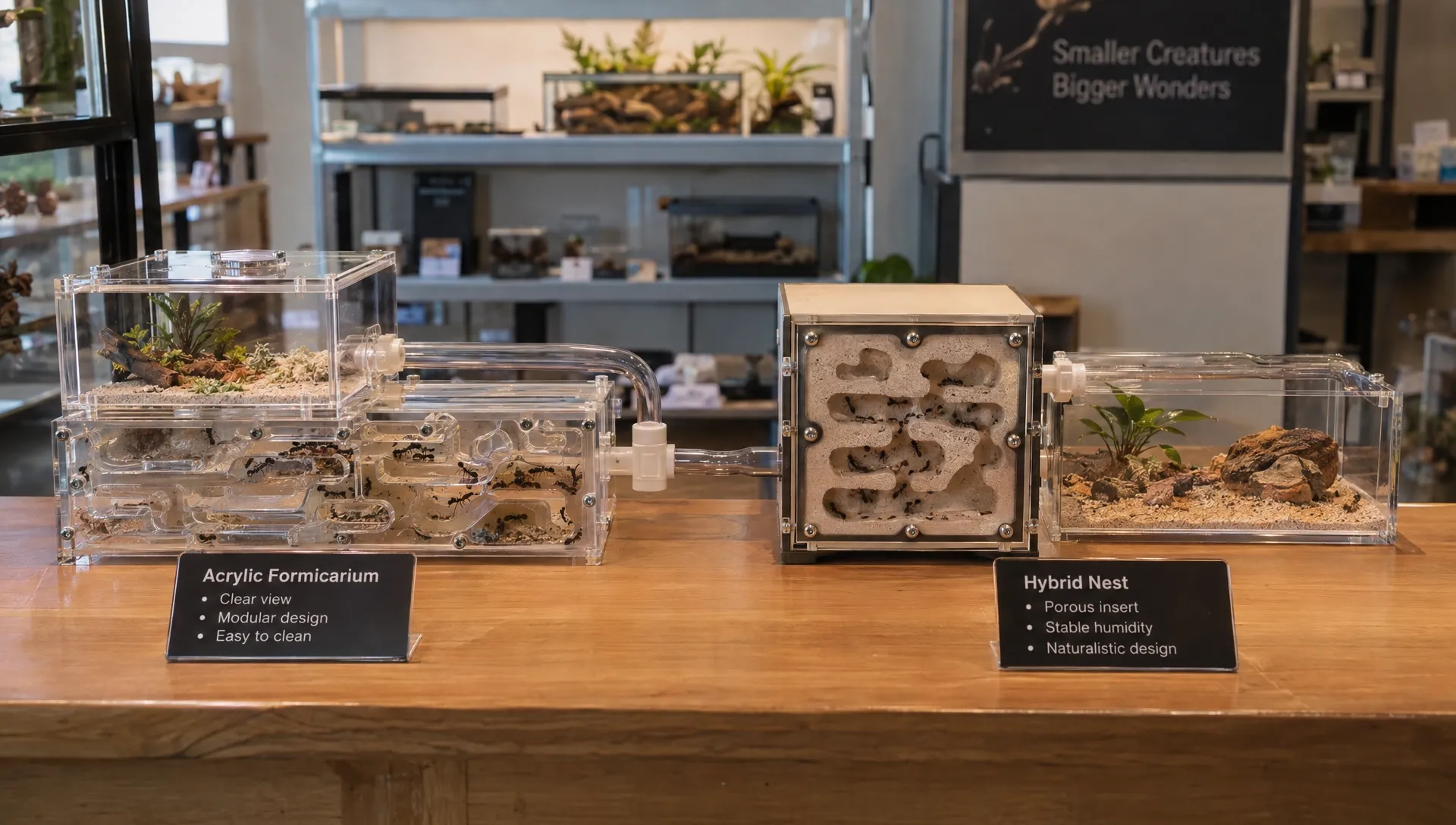
| Hybrid construction | Combines a clear enclosure with a separate nesting medium | Performance depends on how the materials, hydration system and access points work together. |
An acrylic formicarium may offer excellent observation, while a hybrid provides the moisture characteristics you need without giving up a clear view. Neither arrangement is inherently suitable for every species.
For a concrete product comparison, the Terra S Ant Farm kit uses clay-and-sand nesting chambers. It is worth examining alongside all-acrylic designs when comparing nesting substrates, rather than choosing solely by the enclosure’s exterior.
Check chamber fit and escape resistance
Even a suitable material can be part of an unsuitable nest. Check chamber height, connecting passages and access ports against the queen and the smallest workers, not just the average worker.
A large queen needs adequate clearance, while tiny workers may exploit imperfect joints. Ask how the lid is secured, whether unused ports have snug plugs and whether ventilation mesh is suitable for your species. An outworld escape barrier is a secondary precaution, not a repair for gaps in the structure.
For a founding queen or very small colony, moving into a display nest may be unnecessary. Many commonly kept, fully claustral species can begin in a properly maintained test-tube setup. Founding requirements vary, so this is not a rule for every queen.
Choose an acrylic formicarium for the colony you have now, with a practical route to expansion. Excess unused nesting space can become a waste-storage area, making inspection and maintenance harder. There is no reliable universal worker-count threshold because ant sizes and nest layouts differ.
If future expansion is the main attraction, check how unused sections remain closed until needed. The guide to choosing a modular formicarium that can grow with your colony covers that decision in more detail.
Clear walls still require careful maintenance
Visibility makes it easier to notice standing water, trapped workers or accumulating waste. It does not make an occupied nest safe to open whenever you want to clean it.
Remove food remains from the outworld as appropriate for the food and colony conditions. Avoid treating the nest chambers as a feeding tray, particularly where leftovers could become inaccessible. Keep refill points accessible without dismantling the enclosure.
When cleaning an empty acrylic formicarium, follow the manufacturer’s instructions. Acrylic can scratch, and some solvents or alcohol-based cleaners can damage it. Do not assume that a disinfectant safe for glass is safe for acrylic or that its residue is safe for ants.
Before purchasing, establish whether cleaning requires opening occupied chambers. A design that looks convenient when empty may be awkward once the queen and brood are inside.
Keep the habitat out of direct sunlight and away from uncontrolled heat sources. If supplementary heat is appropriate for the species, use a controlled arrangement that allows ants to move away from the warmed area. Do not heat the whole enclosure indiscriminately.
Buying and shipping in Canada
Compare the complete cost of the setup, including compatible tubing, port plugs, hydration components and shipping. A lower-priced nest may not be better value if essential parts must be purchased separately.
Ask whether the parcel contains equipment only or live ants as well. Permission to purchase an empty enclosure does not establish permission to import a colony. For cross-border orders, check the Canadian Food Inspection Agency requirements and applicable provincial rules. US-bound live-ant orders also need checks against the relevant US import and state requirements.
When an acrylic formicarium ships with a colony, ask how weather affects dispatch and whether the seller recommends delaying shipment during unsafe conditions. Shipping availability is not a guarantee that every species can legally or safely travel to every destination.
Be precise about “temperature-controlled” transport. Commercial cooling, such as the systems used in refrigerated vehicle conversions by Peters Koelwagens, serves cargo with specific cooling requirements. It does not establish that refrigeration is appropriate for live ants. Ask your ant supplier about species-appropriate transit conditions, packaging and delivery timing instead.
For local pickup, prepare a secure, shaded place for the journey home. Do not leave a live colony in a parked vehicle while running other errands.
Make the decision with four practical checks
Before committing, you should be able to answer these questions:
- Moisture: How does the nest create and maintain suitable conditions for this species without flooding the chambers?
- Fit: Can the queen move comfortably, and are the smallest workers securely contained?
- Colony stage: Is the accessible nesting area appropriate now, rather than only after substantial growth?
- Maintenance: Can you refill water, remove outworld waste and manage ports without exposing the colony?
Choose an acrylic formicarium when those answers are clear and the design suits your care routine. Prefer a porous or hybrid nest when it offers a more dependable way to meet the species’ moisture needs. Keep a healthy young colony in its existing setup if moving would add risk without solving a problem.
Frequently asked questions
Can ants live directly on acrylic? Some species can live in a suitably designed acrylic nest with appropriate hydration, ventilation and chamber dimensions. The material alone does not establish whether the enclosure is suitable.
Is acrylic bad for species that need humid nests? Not necessarily. The concern is how moisture reaches the nesting space and how consistently it is maintained. A design with an effective hydration insert may work, while bare acrylic with an inadequate water system may not.
Can I move a queen into a display nest immediately? Often there is no benefit to doing so. Many fully claustral founding queens are better left in a suitable test-tube setup until the colony develops. Confirm the founding requirements of your species before choosing a setup.
Why are my ants covering the viewing panel? Some ants use available material to darken or modify their nest. That behaviour is not automatically evidence that the enclosure is unsuitable. Check moisture, temperature and disturbance rather than repeatedly removing their covering.
How much should I spend? Compare the total setup cost and suitability rather than choosing a price bracket first. Include hydration parts, secure connectors and delivery, and remember that a larger nest is not necessarily an upgrade for a small colony.
Get a recommendation for your colony
Before choosing an acrylic formicarium, share your species name, approximate worker count, current housing and room conditions with Ant Farms Calgary. Its kit recommendations and email or WhatsApp support can help you compare suitable options. The aim is a nest your colony can use safely now, not simply the clearest or largest enclosure available.




Leave a comment