If you want an ant colony that grows fast, stays busy and never needs a winter break, Tetramorium bicarinatum is hard to beat. Known as the guinea ant, this small, golden red ant from the tropics lives with many queens in one colony, which means more eggs, more workers and a farm full of activity in a short time.
This guide explains how to identify guinea ants, where they come from, how they behave and breed, and exactly what temperature, humidity and food they need to thrive in an ant farm.
Quick facts
- Scientific name
- Tetramorium bicarinatum
- Common name
- Guinea ant
- Native range
- Tropical Southeast Asia, now spread to warm regions worldwide
- Worker size
- About 3 to 4 mm
- Queen size
- Larger than workers, with a bulky thorax
- Colour
- Golden red to orange brown head and thorax, dark brown to black abdomen
- Queens per colony
- Many (polygyne)
- Ideal temperature
- 24 to 30 °C
- Hibernation
- No, this is a tropical species
- Diet
- Insects, sugars and honey water
- Growth speed
- Fast
- Sting
- Yes, small and mild for people
- Difficulty
- Beginner friendly with a good heat source
How to identify a guinea ant
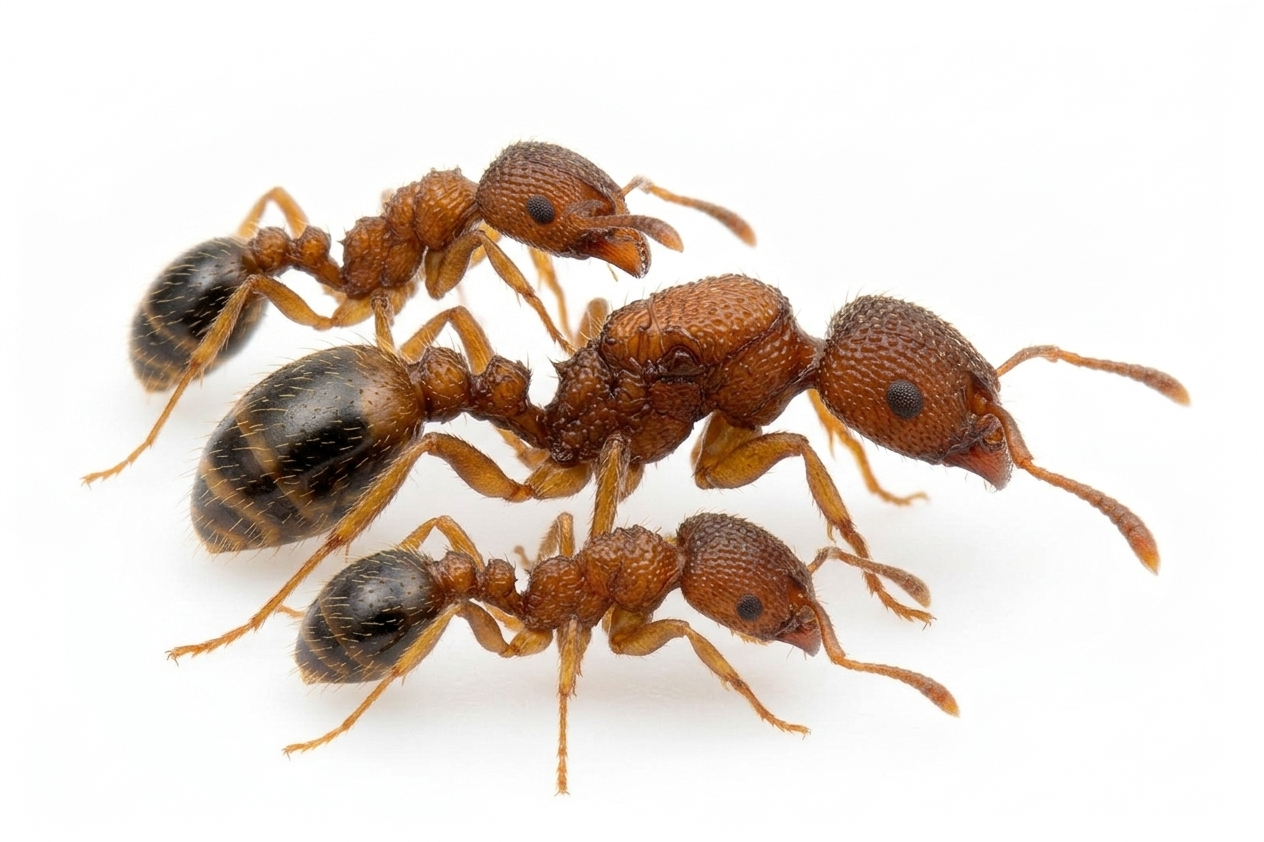
Guinea ants are small but striking. The head and thorax are a warm golden red to orange brown, while the abdomen is much darker, from deep brown to almost black. Under a magnifier you can see fine ridges running along the head and thorax, which give the body a textured, almost carved look.
The name bicarinatum means “two keeled” and refers to the raised ridges on its body. Workers are all about the same size, which makes the colony look very uniform as they march across the outworld.
- Workers: about 3 to 4 mm, compact and sturdy
- Queens: noticeably larger, with a thick, muscular thorax and a larger abdomen
- Males: darker and slimmer, with wings, produced by mature colonies
Where they live
The guinea ant originally comes from tropical Southeast Asia. Over the last few centuries it has travelled the world with people, hitchhiking in plant pots, soil and cargo. Today it lives in warm regions on almost every continent, including the southern United States, Central and South America, Africa and many Pacific islands.
In the wild they nest in:
- Soil, often under stones or logs
- Rotting wood and leaf litter
- Cracks in walls and pavement in warm cities
- Greenhouses and heated buildings in colder countries
Guinea ants are not native to Canada and cannot survive our winters outdoors. Never release them. Keep your colony safely inside its ant farm at all times.
Behaviour and colony life
Guinea ants are energetic and hard working. Workers explore the outworld constantly, find food quickly and recruit nestmates using scent trails, so a cricket can be swarmed within minutes. Watching a well fed colony is like watching a tiny, busy city.
They are confident hunters and scavengers. In the wild they take small insects and other invertebrates, collect sweet honeydew, and clean up dead insects. They will defend their nest firmly against other ants, using their jaws and a small sting.
Behaviours you can watch for:
- Mass recruitment: one worker finds food and soon a trail of ants is carrying it home.
- Teamwork with big prey: several workers pull and carry insects much larger than themselves.
- Brood care: workers move eggs, larvae and pupae around the nest to keep them at the perfect temperature and humidity.
- Many queens together: queens live side by side peacefully, each laying eggs.
Do they sting? Yes, guinea ants have a sting. For people it usually feels like a small prick or a mosquito bite and fades quickly. Simply avoid handling the ants. As with any insect sting, people with allergies should take extra care.
Breeding and life cycle
Many queens, fast growth
Guinea ant colonies are polygyne, which means they have many queens. Each queen lays eggs, so the colony can grow much faster than species with a single queen. A colony starting with a few queens and some workers can reach hundreds of workers within months under good conditions, and eventually many thousands.
From egg to worker
- Eggs: tiny, white and laid in piles
- Larvae: white and fed by the workers with protein and sugar
- Pupae: naked pupae (no cocoon), white at first and darkening as they mature
- Workers: emerge pale and darken over a few days
At warm temperatures around 26 to 28 °C, brood develops quickly. Keep them cooler and everything slows down.
Winged ants
Mature, well fed colonies produce winged queens and males. In the wild these leave the nest to mate and start new colonies or join existing ones. Seeing winged ants in your farm is a sign of a healthy, mature colony. Keep the farm closed so none can escape.
Temperature and humidity
This is a tropical ant, so warmth is the single most important part of keeping guinea ants happy.
- Ideal range: 24 to 30 °C, with brood growing best around 26 to 28 °C.
- Below 20 °C: the colony slows down a lot and brood production may nearly stop.
- Heat source: in a Canadian home you will usually need a small heat mat or heat cable on one side of the nest. Heat only part of the nest so the ants can choose their spot.
- Humidity: keep one area of the nest moist and another drier. Guinea ants like a moderate to high humidity area for their brood.
- No hibernation: unlike Canadian species, guinea ants stay active all year and must never be cooled down for winter.
Use a thermostat with your heat mat and never cover the whole nest with heat. Overheating is the most common mistake with tropical ants.
Feeding
Guinea ants have big appetites, especially when the colony is growing quickly. They need a steady supply of protein plus sugar for energy.
Protein
- Crickets, mealworms, roaches or fruit flies, pre killed and from a clean source
- Crack larger insects open so the small workers can reach the soft insides
Sugars
- Honey water or sugar water
- Small pieces of fruit, removed before they go mouldy
Feed protein at least twice a week, more often for big colonies with lots of larvae. Remove leftovers after about 12 hours to keep the outworld clean and mould free.
Keeping them in an ant farm
Guinea ants are a great choice for beginners who want fast results and do not want to deal with hibernation. Their only real requirement is warmth.
Because the colony grows quickly, plan for expansion from the start. A modular farm is ideal, because you can add new sections as the colony fills the old ones.
- Modular Farm 2XL kit for a starting colony
- Modular Farm 3XL kit or larger for fast growing colonies
- Expansion modules to keep up with growth
Workers are small, so check that the lid and every connection are tight. A thin escape barrier on the upper walls of the outworld adds extra peace of mind.
Watch them in action
This care guide video shows a guinea ant colony up close, including the many queens, the brood and how the workers handle food.
Get a fast growing guinea ant colony
Our Tetramorium bicarinatum colonies come with multiple queens, workers and eggs, raised by experienced keepers in Calgary and covered by our Live Arrival Guarantee.
Frequently asked questions
Are guinea ants good for beginners?
Yes. They are tough, grow quickly and do not need hibernation. Their main need is a warm nest, which a small heat mat with a thermostat easily provides.
How fast do Tetramorium bicarinatum colonies grow?
Very fast compared to most species, because each colony has several egg laying queens. With warmth and plenty of protein, a colony can reach hundreds of workers within months.
Do guinea ants sting?
Yes, they have a small sting. For most people it feels like a mild prick that fades quickly. Avoid handling the ants.
Do guinea ants need hibernation?
No. They are a tropical species and should be kept warm all year.
What temperature do guinea ants need?
Between 24 and 30 °C, with the brood area ideally around 26 to 28 °C.
Can I release guinea ants outside?
No. They are not native to Canada and should never be released. Always keep them inside their ant farm.