
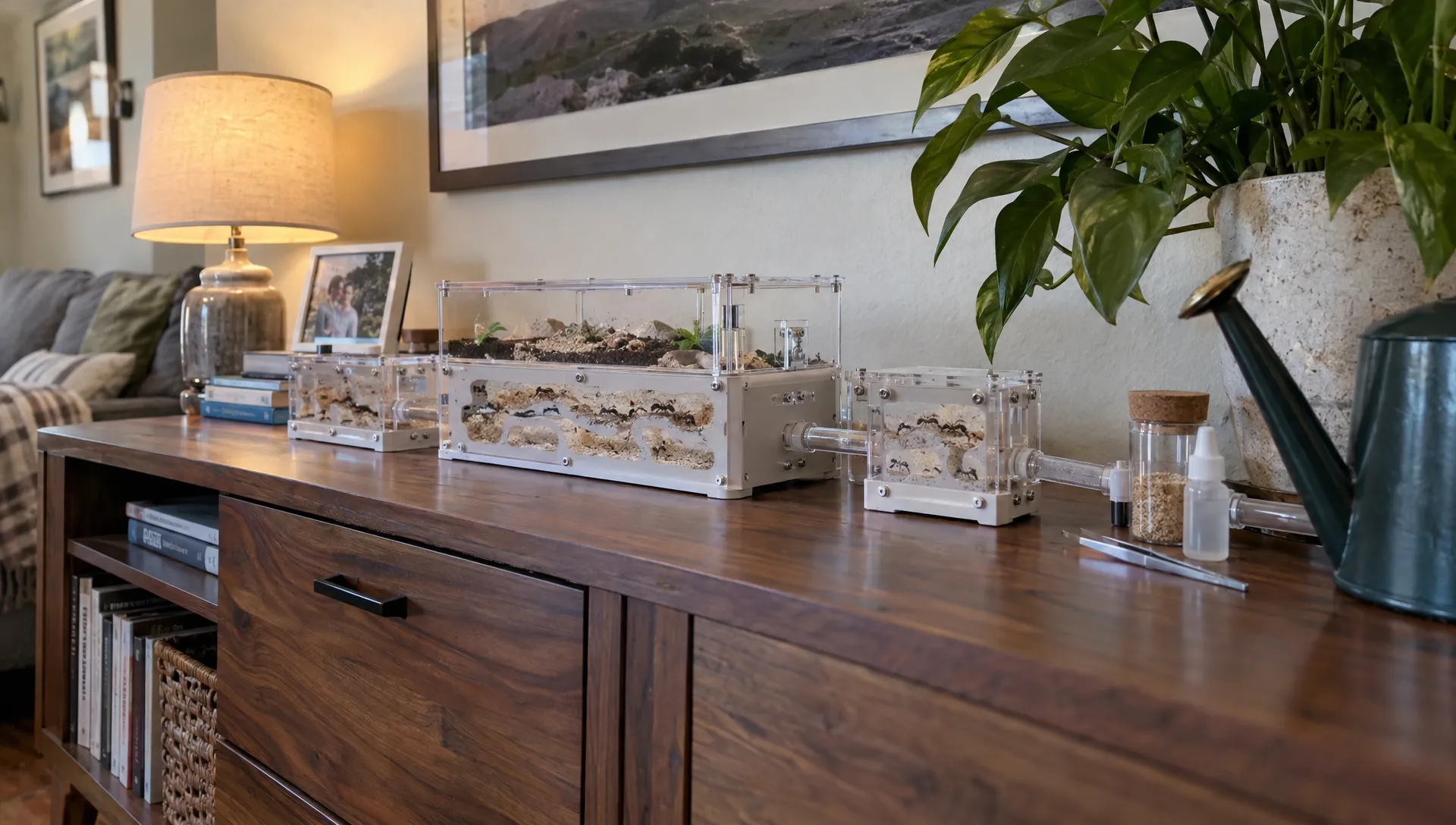
Adding a modular ant nest should solve a housing problem, not create a new one. Before connecting an extension, check whether your colony needs more nesting space, whether the parts actually fit and whether you can hydrate and service the new section without opening an escape route.
External dimensions and advertised ant capacities are only starting points. The useful checks happen closer to the colony: chamber height, worker size, brood placement, connector security and the conditions inside the nest. Use the following checklist before ordering an extension or opening a connection port.
1. Confirm that you need more nesting space
A busy feeding area does not necessarily mean the nest is overcrowded. Workers may gather around food or explore an outworld even when plenty of usable chamber space remains.
Look at where the queen, brood and resting workers spend their time. Expansion becomes more useful when the colony consistently occupies most suitable chambers and has little room to accommodate additional brood. One crowded-looking feeding session is not enough evidence.
A founding queen or small colony may still be better served by a properly maintained test tube. Our guide to preparing ant tubes for founding queens explains that earlier housing stage.
If the problem is awkward feeding or limited waste-removal space, an arena extension may be the better addition. An outworld module adds activity space, but confirm its connection requirements before assuming it fits your existing setup.
Check before proceeding: Identify whether you need more brood chambers, more foraging room or easier maintenance. These are different problems.
2. Will this modular ant nest suit your species?
Judge the usable interior rather than the footprint of the enclosure. Two nests with similar outside dimensions can have very different chamber heights, tunnel widths and moisture distribution.
Ask the seller which species and colony stages the design suits. A capacity estimate expressed as a number of ants is approximate, not a universal limit. Worker sizes vary between species and sometimes within a single colony.
Check that the queen can pass through the narrowest intended route and that the chambers suit the species’ nesting behaviour. Also look for inaccessible recesses where food could accumulate unnoticed. An oversized addition can leave more unoccupied space available for waste storage.
Material matters mainly because of how it performs. Glass and acrylic provide visibility but do not, by themselves, distribute moisture like a porous insert. Gypsum and other absorbent components need their own hydration and cleaning instructions. Wood or cork components require care suited to those materials.
Check before proceeding: Obtain internal chamber dimensions and material details, not just an overall product measurement or an estimated colony capacity.
3. Measure every connection before ordering
A modular ant nest is only compatible with your setup if its actual connection system matches. The word “modular” does not establish a shared standard across brands, product families or older revisions.
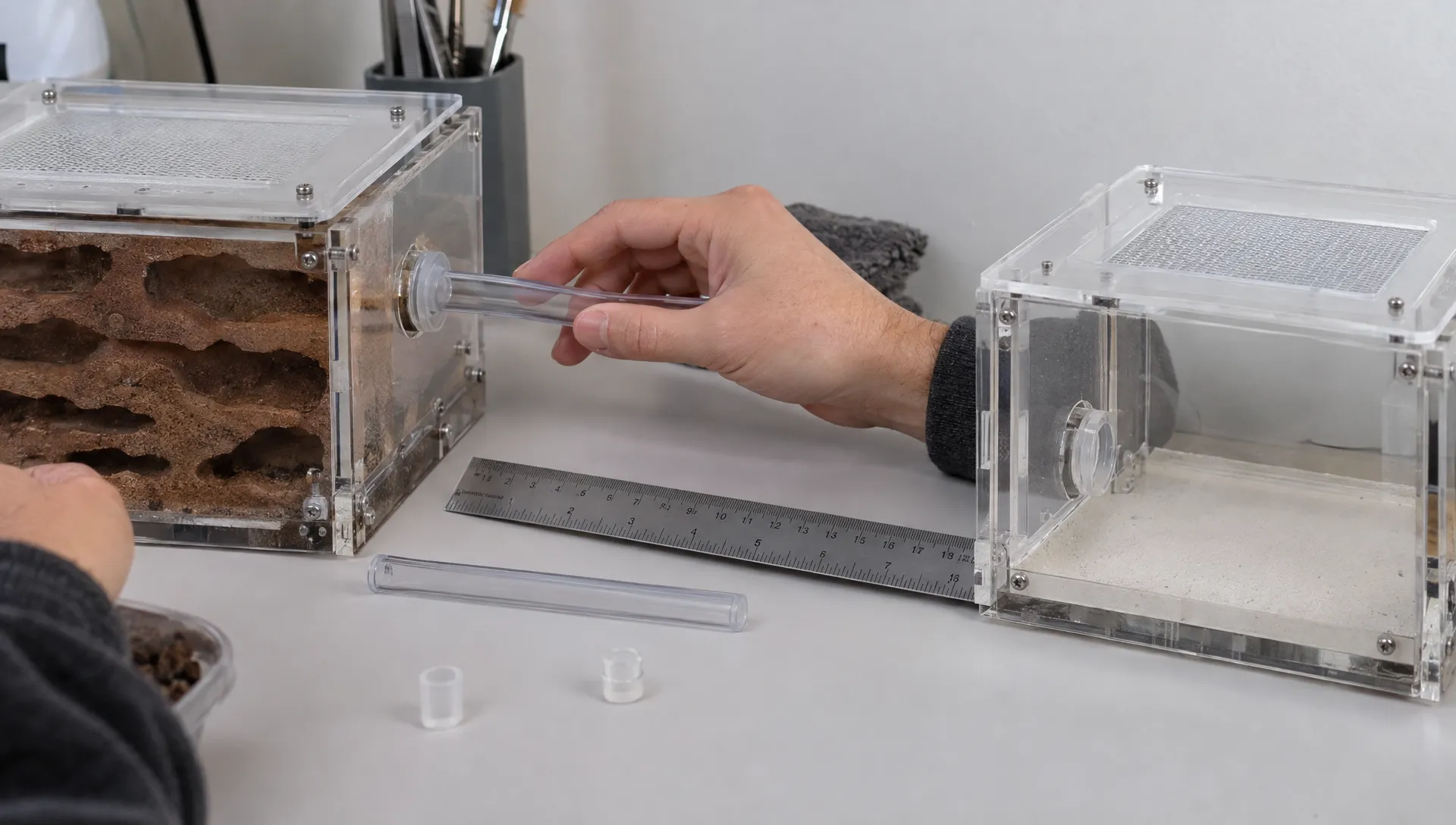
Record the measurements from your current equipment and compare them with the proposed extension. A photograph beside a ruler can help a seller identify a part, but written dimensions are still useful.
| Connection detail | What to verify | Why it matters |
|---|---|---|
| Tubing dimensions | Internal diameter and external diameter | A quoted tube size may refer to either measurement |
| Port design | Push-fit tube, sleeve, threaded fitting or proprietary connector | Similar-looking openings may need different adapters |
| Engagement depth | How far the tube or connector must seat | Shallow connections can pull free when equipment moves |
| Unused openings | Correctly fitting plugs or caps | Every additional port creates another potential escape point |
| Product revision | Compatibility with your existing model | An updated fitting may differ from an older version |
Ask whether adapters, tubing and plugs are included or sold separately. Confirm that the connection will not put sideways pressure on a port when the modules sit in their final positions.
Do not rely on tape or improvised packing to rescue a loose connection. Obtain a correctly fitting component before introducing ants.
4. Test hydration before ants enter
Hydrate the empty module according to its instructions, then observe how it behaves in the room where it will operate. Check for leaks, standing water, persistent condensation and moisture reaching areas intended to stay dry.
The hydration system in a modular ant nest must suit both the species and your maintenance routine. A reservoir is not proof that every chamber receives suitable moisture, and a damp-looking surface does not tell you the humidity throughout the nest.
Ask how water reaches the nesting area, how you recognise the need for a refill and whether the moisture-bearing component can be replaced. Confirm whether refilling requires opening any part accessible to ants.
There is no single refill interval that works for every nest. Room temperature, ventilation, materials and seasonal indoor dryness all influence water loss. Drinking water should also remain available independently of your assumptions about nest moisture.
If heating is appropriate for the species, follow species-specific guidance and the enclosure manufacturer’s limits. Do not combine an unfamiliar heater and a newly connected nest as one untested change.
Check before proceeding: You should understand where water goes, how excess moisture is avoided and how you will refill safely.
5. Inspect escape points and maintenance access
Examine the empty enclosure under good light. Check lid edges, ventilation mesh, cable openings, seams and every removable plug. Small workers may exploit a gap that looks insignificant beside a larger ant.
Escape prevention in a modular ant nest depends on the entire enclosure, not just the connection tube. Ventilation openings must retain the smallest workers while providing airflow appropriate to the design.
Gently test whether lids, clips and plugs remain seated during ordinary handling. Route tubing so it cannot be snagged while feeding or cleaning. The modules should sit securely without the tube pulling either unit towards the edge of a shelf.
Next, rehearse routine maintenance while everything is empty. Can you remove food remains from the arena? Can you refill water without disturbing a connector? Can you inspect the nest without lifting a lid that contains workers?
An escape barrier, where suitable for the species and enclosure, is an additional safeguard rather than a substitute for secure construction. Apply and maintain it according to the product instructions, keeping it away from nesting surfaces and water.
Check before proceeding: If an ordinary care task requires opening an occupied chamber, clarify the intended maintenance method before connecting it.
6. Plan for Canadian seasons and replacement parts
Consider where the expanded setup will sit through the year. Indoor heating can change drying rates during a Canadian winter, while a sunny window can expose an enclosure to unwanted temperature swings.
For species that require a seasonal rest period, establish the appropriate conditions before expanding. Avoid making a routine housing change during dormancy preparation unless a welfare problem makes it necessary. Do not use a universal winter schedule for every species.
Check whether the connected assembly fits the space where you provide seasonal care. Also ask whether replacement plugs, connectors and hydration components are available separately. A low-priced extension is less useful if one missing fitting leaves it unusable.
Shipping deserves its own check. Confirm the delivery location, expected handling arrangements and what to do if glass or fittings arrive damaged. Inspect empty equipment before scheduling a colony transfer.
For clubs or retailers importing empty enclosures in bulk, freight forwarding and customs coordination belong in the landed-cost calculation. Live ants require a separate review of current species restrictions and transport requirements; shipping arrangements for hardware do not establish permission to move a colony across borders.
7. Rehearse the connection before opening a port
Complete a dry fit with the new module empty and the colony securely contained. Place both units in their intended positions and check that the tubing follows a stable route without kinks or tension.
Set out the correct plugs and any tools before beginning. Work in an uncluttered area with secondary containment appropriate to the species. A tray can help organise equipment, but its sides alone should not be treated as escape-proof.
Keep unused ports closed and expose only the connection you are actively working on. Follow the manufacturer’s connection sequence rather than improvising while workers investigate an opening. If the design cannot be connected safely while occupied, ask the seller for a suitable procedure.
Once the new modular ant nest is securely attached, allow the colony to investigate it without forcing an immediate move. Keep the existing nest functional during the transition.
Do not shake ants out, flood chambers or use excessive heat to drive them towards the extension. If you intend to retire the old nest, first confirm where the queen, brood and workers are located. Any remaining occupants need a safe route out before that section is isolated.
Check before proceeding: You should be able to explain the connection sequence and how you would close the system if something did not fit.
8. Decide what you will monitor afterwards
Record the hydration setup and take a photograph of the connected modules. That gives you a reference for moisture changes, loose fittings and chamber occupancy without repeatedly disturbing the colony.
During your normal observation routine, look for water pooling, unusual condensation, debris at a connector or workers probing a seam. Check the physical connection again after moving either enclosure or servicing nearby equipment.
Ants may explore an addition before occupying it. Continued use of the original nest does not automatically mean something is wrong. Compare the new section’s conditions with the colony’s established preferences rather than repeatedly changing moisture, temperature and lighting together.
If the colony does not need the extra chambers yet, keeping the modular ant nest safely closed off may be preferable to leaving unnecessary space accessible. Use the intended plug or gate system, and never isolate a section containing ants or brood.
The useful outcome is a stable extension that makes care easier, not simply a colony that moves quickly.
Frequently asked questions
How many workers should a colony have before expansion? There is no reliable universal number. Species, worker size, brood volume and usable chamber space matter more than a single headcount. Compare current occupancy with the proposed nest’s internal dimensions.
Can I connect modules from different brands? Sometimes, but only after verifying port dimensions, tubing measurements and any adapter requirements. A shared description such as “medium connector” does not prove compatibility.
Does a modular ant nest need a separate outworld? It needs suitable foraging space, but that may be integrated or separately connected. Confirm where feeding, drinking water and waste removal will take place before buying an extension.
Can I clean a module while the colony uses it? Routine arena cleaning may be possible without disturbing the nest. Deep cleaning of nesting chambers should wait until the module is empty and safely isolated. Follow the material-specific cleaning instructions and avoid leaving cleaning residues.
Check the fit before you expand
Before ordering, gather your species name, approximate worker count, current setup photos and connector measurements. These details make a recommendation more useful than choosing by advertised capacity alone.
Ant Farms Calgary offers modular farms, extensions and personalised kit advice. Ask about compatibility, hydration requirements and replacement parts before connecting your next section, especially if your existing equipment comes from another product range.




Leave a comment