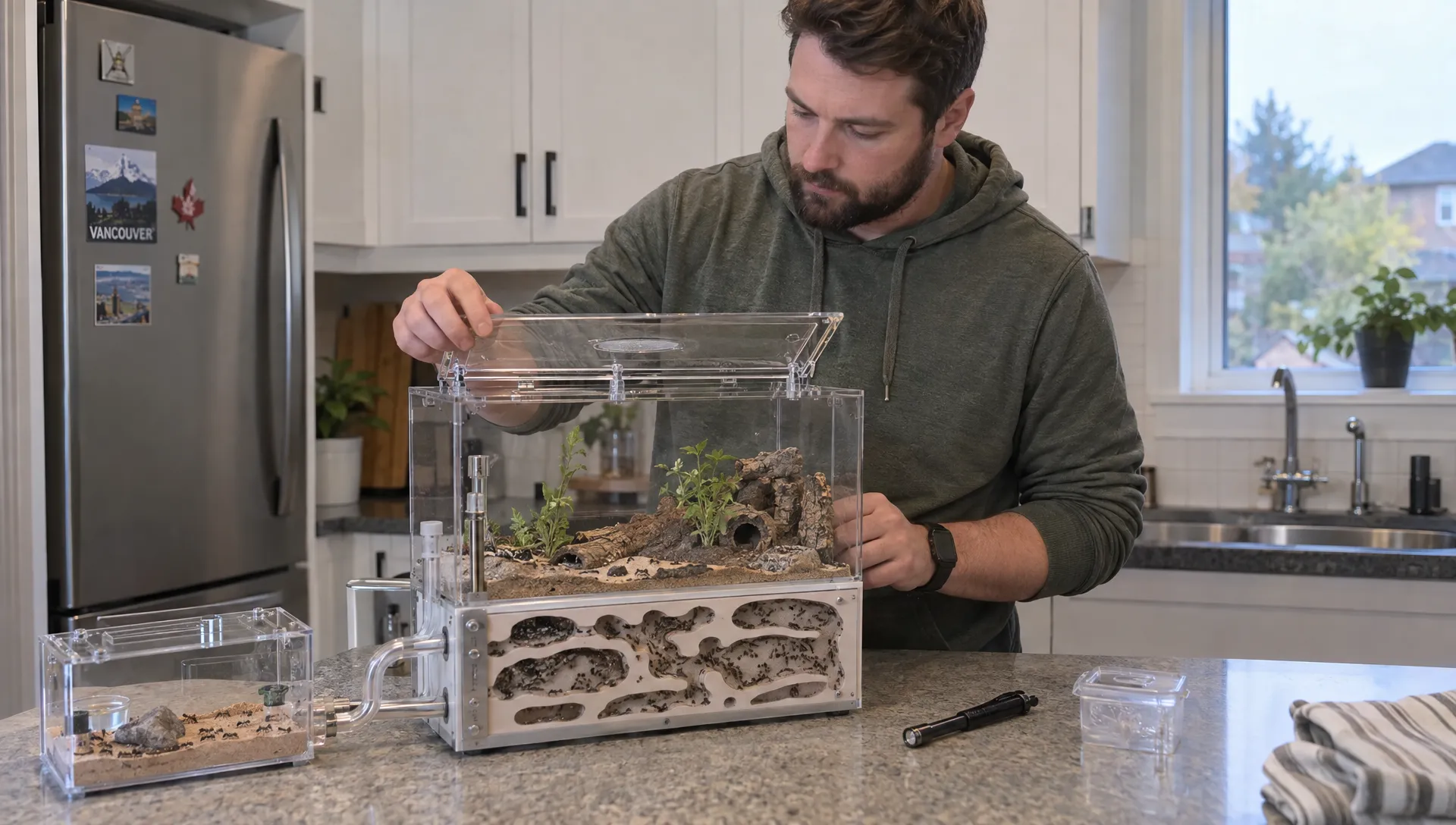
A safe home for ants indoors gives a captive colony somewhere secure to nest, reliable access to water and conditions suited to its species. It also protects your household from escapes. A clear container alone is not enough: the lid, ventilation, hydration system and feeding access all need to work together.
The right setup depends on the ants you keep and their stage of growth. A founding queen may need a small test-tube nest, while an established colony needs nesting chambers connected to a separate foraging area. Before choosing an enclosure, confirm the species, worker size and care requirements with the supplier.
Start with the colony, not the container
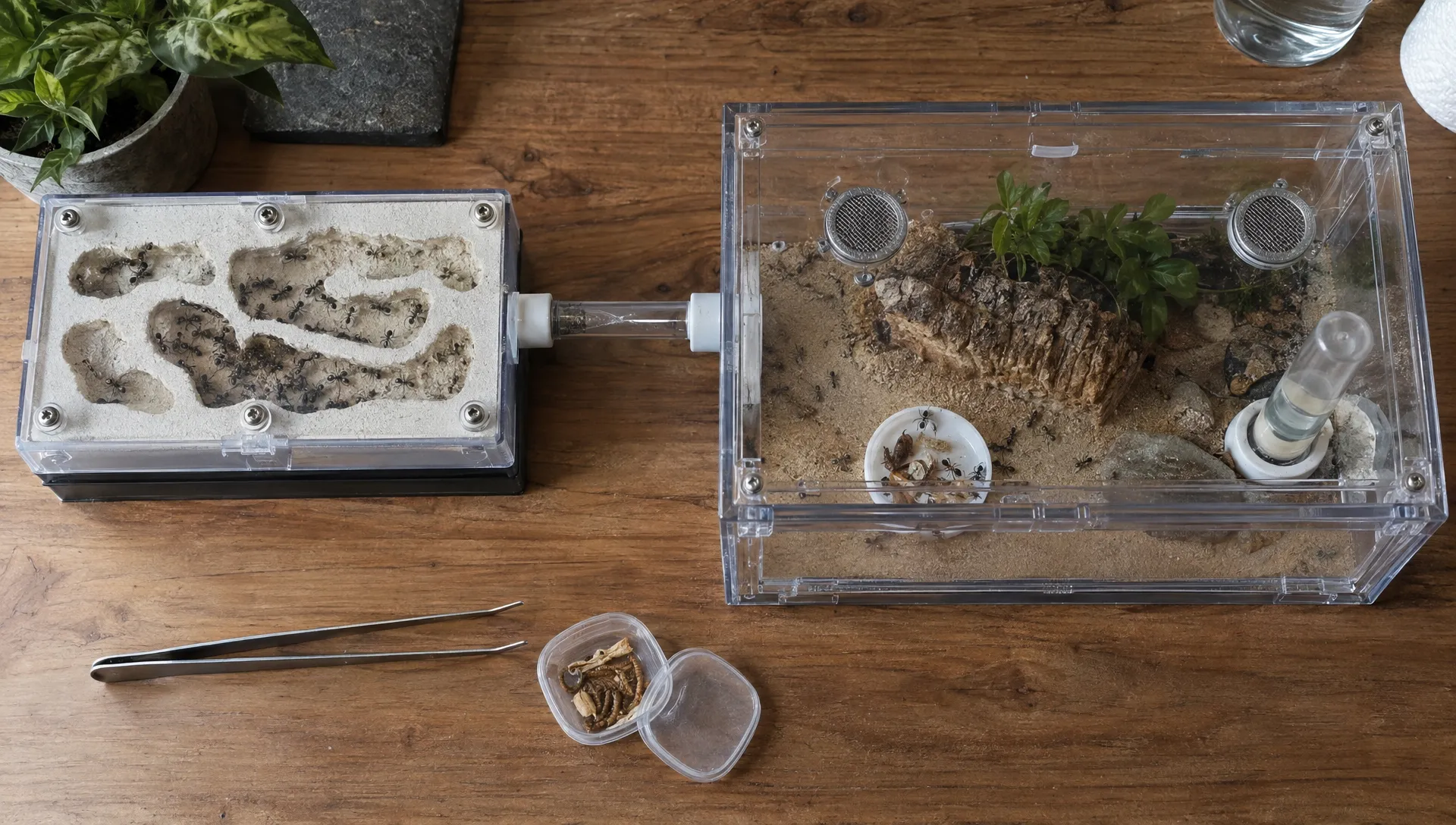
An ant habitat usually has two functional spaces. The nest holds the queen, developing brood and resting workers. The outworld provides space for feeding, foraging and waste disposal. These areas need not be large, but they should be easy to maintain without repeatedly disturbing the colony.
Match the nest to colony size
More space is not automatically better. In an oversized nest, ants may put food scraps and rubbish into unused chambers that you cannot easily clean. Small colonies can also be harder to observe when they disappear into a large network of rooms.
A suitable home for ants should accommodate the colony as it is now, with a practical way to expand later. Many founding queens do well in properly prepared test-tube setups, although feeding needs differ between fully claustral and semi-claustral species. Follow the species-specific founding instructions rather than assuming every queen needs the same treatment.
Choose materials for function
Acrylic, glass, plaster and aerated concrete can all have a place in ant keeping, but they manage moisture differently. Some ants can also damage particular nest materials. Ask whether the enclosure suits the species, not simply whether it is sold as an ant farm.
Gel habitats are not a dependable substitute for a species-appropriate nest, water supply and diet. When comparing ant farm kits and expandable enclosures, prioritise accessible hydration, secure connections and manageable chamber sizes over decorative features.
How should a home for ants prevent escapes?
Physical containment should come first. A tight-fitting lid, securely attached ventilation mesh and properly capped ports matter more than any escape-prevention coating. The smallest workers determine how fine the openings must be, not the queen or the largest ants.
Check the entire route from nest to outworld. Tubing should fit firmly without being stretched, kinked or left pulling sideways on a connector. An unused expansion port is still an escape route unless it has an appropriate secure closure.
Ventilation mesh needs to be fixed around its edges. A suitably fine mesh offers little protection if workers can move underneath it. Likewise, a lid that lifts at one corner may be unsafe even when the rest looks flush.
An ant-keeping barrier can provide additional protection around an outworld opening, but its effectiveness depends on the product, species and surface condition. Keep it away from food and water, follow its instructions and inspect it regularly. Do not substitute household insecticides, essential oils or improvised chemical repellents.
Plan for feeding time, too. Keep tools within reach before opening the enclosure, open only what you need and close it immediately afterwards. A high-sided work tray can help contain an accident, but it does not replace a secure habitat.
Balance water, airflow and humidity
A healthy home for ants provides moisture without turning every surface wet. Many species benefit from a moisture gradient, allowing workers to move brood between more humid and drier parts of the nest. The correct balance depends on the species and nest design.
Drinking water and nest humidity are related, but they are not interchangeable. A damp nest does not necessarily provide an accessible drinking source. Use an appropriate protected feeder or a correctly prepared test-tube reservoir rather than an open dish in which small workers could drown.
In a test-tube setup, a securely positioned cotton plug separates the colony from the water reservoir. Check for leaks and declining water levels without repeatedly handling the tube. If the reservoir is running low, prepare a suitable replacement before the colony runs out.
Ventilation helps manage moisture, but excessive airflow can dry a small nest quickly. Canadian indoor heating can make this especially noticeable during colder months. Watch the actual reservoir and nesting conditions rather than following a watering schedule unchanged throughout the year.
Persistent pooling, spreading mould or a waterlogged chamber needs attention. Condensation alone does not prove that a nest is dangerously wet, but droplets forming accessible pools are a reason to inspect the setup. Avoid flooding a nest to correct dryness quickly.
Choose a stable indoor location
Where you place a home for ants affects its safety as much as the enclosure itself. Choose a level, stable surface away from direct sun, heating vents, radiators and frequently opened exterior doors. A sunny window can heat a clear enclosure even when the room feels comfortable.
Use a thermometer near the habitat to check conditions. If the species requires supplemental heating, use an appropriate controlled system that leaves a cooler retreat. Never heat the whole enclosure indiscriminately or place a heat source directly against a water reservoir without a suitable setup.
Keep the habitat beyond the reach of children and pets. Tubing should not hang over an edge where it can be pulled, and a shelf should support the full setup without wobbling. Avoid frequently moving the colony between rooms for viewing.
Household chemicals also influence placement. A dressing table used for perfume, cosmetics or cleaning fine jewellery is a poor location because spills and aerosols are difficult to control. Keep cleaning sprays, insecticides and scented products away from an open habitat.
Finally, check seasonal requirements. Many temperate species need a period of reduced activity or diapause, but the temperature, timing and duration vary. A warm living room year-round is not automatically suitable, and an unmonitored garage is not a safe substitute for a planned winter-care arrangement.
Make routine care possible without disturbing the nest
An easy-to-maintain home for ants lets you replace food, inspect water and remove rubbish without dismantling the nesting area. Before buying, consider how your hand or feeding tools will reach the outworld and whether connectors will remain secure during maintenance.
Put food on a removable feeding surface rather than directly onto porous nest material. Offer manageable portions and remove uneaten perishable food before it spoils. A large meal that sits untouched creates more cleaning work, not better nutrition.
Liquid foods need particular care with tiny workers. Use an appropriate feeder or suitably small servings that do not create a drowning hazard. Match feeding to the species and colony stage; the guide to choosing ant food as a colony grows explains that distinction in more detail.
Keep decoration simple enough to inspect. Loose objects should not topple, block an entrance or bridge an escape barrier. Avoid outdoor materials that may carry pesticide residues, mites or other unwanted organisms. Use clean, suitable accessories and fully cured materials intended for the enclosure.
Check accessible water, closures and room conditions daily without uncovering the nest unnecessarily. Founding queens especially benefit from limited disturbance. Reliable observation does not require repeatedly lifting covers or moving the colony into bright light.
Test the setup before moving the colony
Prepare a home for ants before the animals arrive, while you can still adjust fittings without risking an escape. Run the hydration system according to its instructions and confirm that water reaches the intended area without flooding chambers or leaking onto the shelf.
Use this short inspection before introducing the colony:
- Closures: Check that the lid sits evenly and every unused opening has a secure cap or plug.
- Connections: Confirm that tubing and adapters fit firmly without strain or gaps.
- Ventilation: Inspect both the mesh openings and the attachment around every edge.
- Water: Verify that the reservoir or feeder works without exposing workers to deep liquid.
- Access: Practise reaching the feeding area and closing the enclosure without shifting the nest.
Check temperature over a normal day, including when sunlight reaches the room or the heating switches on. A single comfortable reading can miss a recurring hot period.
When it is time to move the ants, follow a method appropriate to their current container and species. Where practical, offer a connected, prepared nest and allow relocation rather than shaking or tipping ants into chambers. Do not force a settled founding colony into a larger enclosure solely for a better view.
Recognise problems before making major changes
A safe home for ants still needs observation after move-in. Look for changes from the colony's normal behaviour, then check measurable conditions before altering the habitat. One restless worker or a small patch of condensation is not enough to diagnose a problem.
| What you notice | What to check first | Practical response |
|---|---|---|
| Ants appearing outside the enclosure | Lid edges, ports, tubing and mesh attachments | Secure the enclosure and locate the route before reopening it |
| A reservoir emptying unexpectedly quickly | Leaks, heat exposure and evaporation | Correct the cause and restore safe access to water |
| Wet food or mould accumulating | Portion size, food placement and inaccessible waste | Remove accessible spoiled material and adjust feeding |
| Sudden widespread frantic activity | Direct sun, actual temperature and recent disturbance | Remove the immediate stressor without abruptly chilling the colony |
| An unusual increase in deaths | Water access, temperature, contamination and recent changes | Contact the supplier with photographs and care details |
Avoid responding to every concern by adding more water, more heat or more food. Change one relevant factor at a time when possible, and record what changed. If the problem involves the occupied nest, seek advice before taking it apart.
Frequently asked questions
How long can a home for ants last? A suitable enclosure can serve a colony for years if its materials, closures and hydration system remain sound. Colony lifespan is a separate question: a queenright colony can persist as new workers replace older ones, while a worker-only display cannot sustain that cycle indefinitely. Expansion may be needed as the colony grows.
Can I keep ants in an ordinary jar? A jar is not automatically a safe habitat. It still needs escape-proof ventilation, appropriate nesting conditions, safe water access and a practical way to feed the ants. Purpose-built equipment usually makes those requirements easier to manage.
Are indoor ant farms suitable for children? They can support supervised observation, but an adult should oversee species selection, containment and care. Consider biting, stinging and escape risks before buying. Children should not open the enclosure or handle ants unsupervised.
What should I do if I cannot keep the colony anymore? Contact the supplier or an experienced keeper about lawful rehoming. Never release a captive colony outdoors, even if you believe the species occurs locally. Check the relevant rules before moving ants across provincial or international borders.
Choose a setup you can maintain confidently
Start with the colony's identity, current size and seasonal needs, then choose equipment that makes containment and everyday care straightforward. Ant Farms Calgary offers starter kits, modular farms and personalised recommendations. If you are unsure which setup fits your colony, ask Ant Farms Calgary for guidance before moving the ants into a new enclosure.




Leave a comment