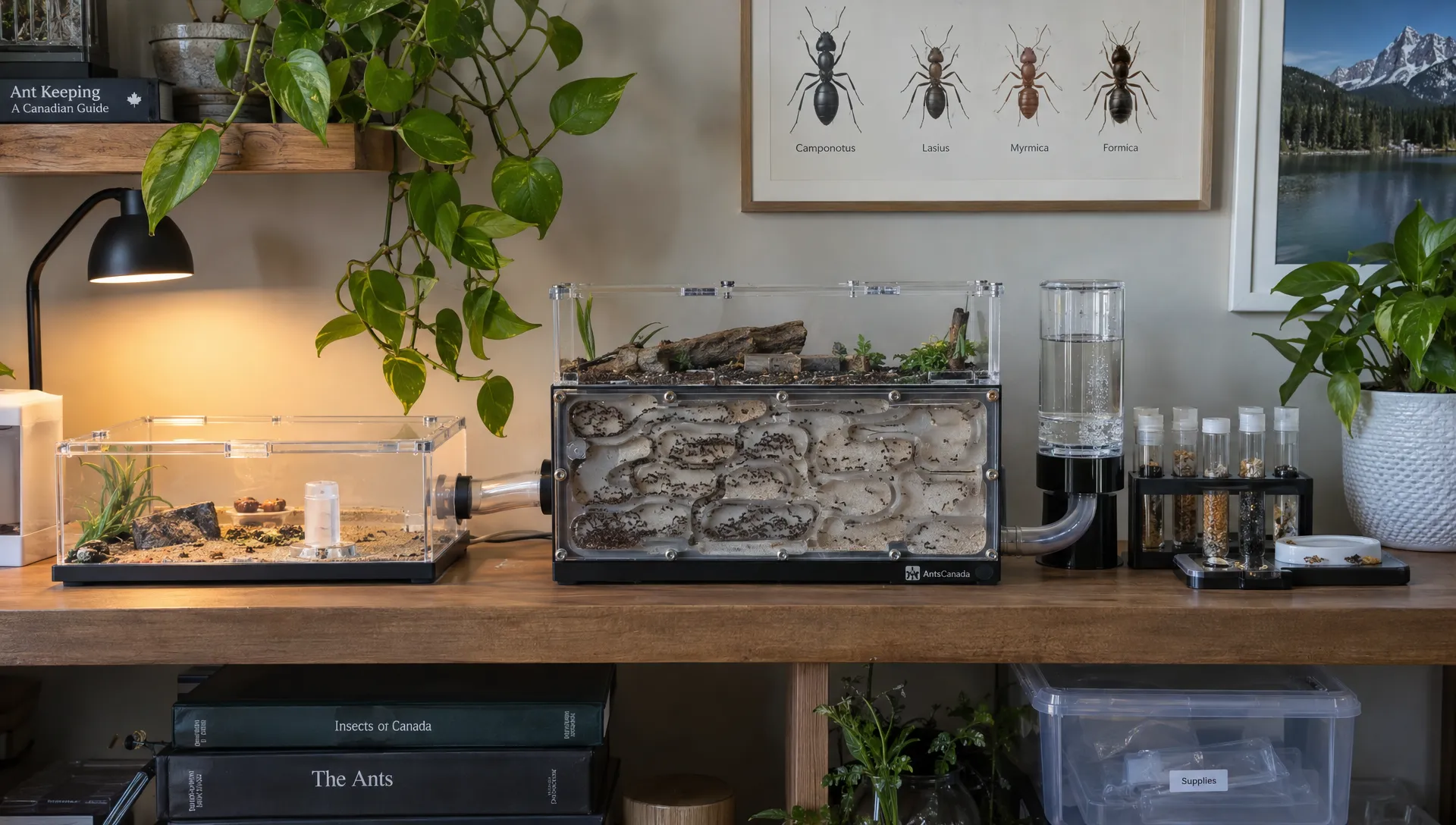
Choosing ant food starts with two questions: what species are you keeping, and what is happening inside the nest? A founding queen living on stored reserves has different needs from a colony raising dozens of larvae. Worker numbers help you estimate portions, but brood development often tells you more about protein demand.
This guide explains what to offer at each growth stage, how to judge portions and when to change your feeding routine without creating waste or disturbing the colony.
How ant food needs change as a colony grows
For many commonly kept omnivorous ants, a feeding plan has three essentials: carbohydrates, protein and reliable access to water. Seed harvesters and fungus-growing species need a different approach, so confirm your species before choosing a diet.
Adult workers use sugars to fuel foraging, nest maintenance and brood care. Protein supports larval growth and queen reproduction. Growing larvae, rather than eggs or pupae, are the main brood-related signal to watch when adjusting protein offerings.
More protein is not automatically better. A study by Audrey Dussutour and Stephen Simpson found reduced worker survival under high-protein experimental diets. That finding does not establish a universal feeding ratio, but it reinforces the need to balance protein with carbohydrates rather than treating insects as the entire diet.
Good ant food should meet the colony’s current needs in a form its workers can safely collect. Water remains essential even when nectar or sugar water is available.
A feeding overview by colony stage
These stages describe changes in feeding behaviour, not fixed worker-count thresholds. A small colony with many larvae may need more protein than a larger colony with little developing brood.
| Colony stage | Main feeding priority | Practical approach |
|---|---|---|
| Fully claustral founding queen | Water and minimal disturbance | Usually leave unfed until workers emerge, following species-specific guidance |
| Semi-claustral founding queen | External food during founding | Offer small, accessible portions appropriate to the species |
| First workers | Safe access and manageable portions | Introduce tiny carbohydrate and protein offerings |
| Expanding colony with larvae | Support brood growth without excess waste | Adjust protein portions using feeding response and leftovers |
| Established colony | Consistent supply and easy maintenance | Scale portions and feeding access to actual consumption |
| Colony entering diapause | Follow seasonal physiology | Adjust feeding to activity and species-specific care requirements |
Founding queens: identify the founding strategy first
Fully claustral queens
A fully claustral queen normally raises her first workers using stored body reserves while remaining inside a protected founding chamber. Many commonly kept Camponotus and Lasius species follow this pattern, although you should confirm the requirements of the particular species.
For these queens, routinely opening the tube to add food can introduce more disturbance and contamination than benefit. Maintain the appropriate founding setup, including its water reservoir, and avoid feeding unless species-specific guidance or the queen’s condition calls for intervention.
The correct ant food decision at this stage may be to offer nothing yet. That is a feature of the founding strategy, not evidence that adult ants never need feeding.
Semi-claustral queens
Semi-claustral queens need external food while founding. They require a secure way to reach suitable carbohydrate and protein sources without exposing the nest to unnecessary disturbance.
Offer very small portions in a feeding area and remove leftovers promptly. If you do not know whether your queen is fully or semi-claustral, establish that before choosing a feeding schedule. Guessing can mean either unnecessary disturbance or a genuine food shortage.
First workers: make food accessible, not abundant
The first workers are often smaller than later generations. Their arrival is the point to begin offering food to many previously unfed, fully claustral colonies, using a feeding arrangement suited to their size.
For an omnivorous species, start with a small carbohydrate offering and a tiny piece of an appropriate, captive-reared feeder insect. Cutting open a pre-killed insect can expose soft tissue that small workers can access more easily than an intact, heavily armoured feeder.
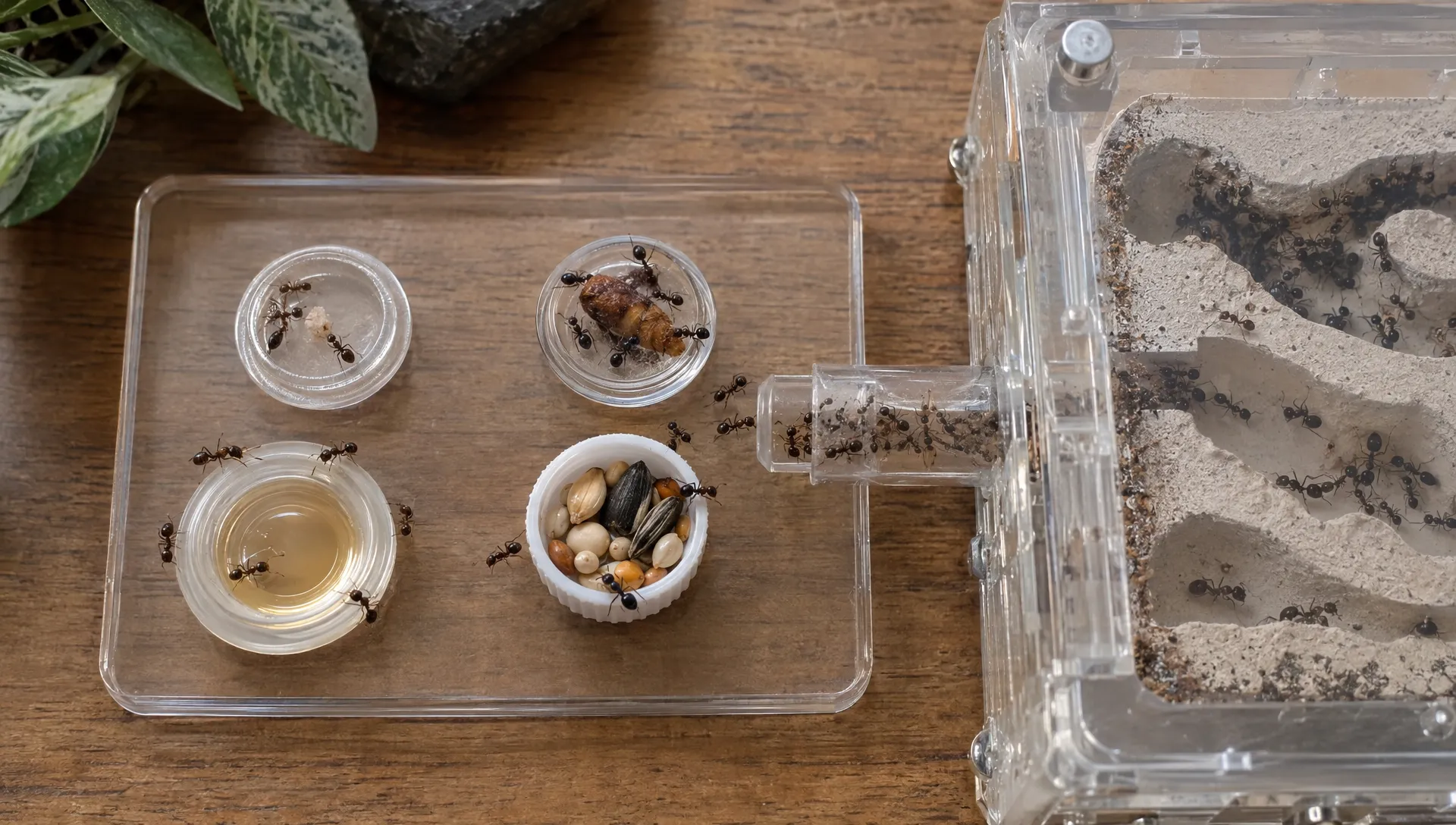
At this stage, ant food should be easy to collect without requiring workers to struggle with large prey or cross exposed liquid. Use a feeder designed for the size of your ants, or a suitable wick that does not leave a deep pool. Sticky droplets can trap small workers.
As an illustrative first offering, a colony with only a few workers might receive a pinhead-sized piece of soft insect tissue. That is a cautious starting point, not a universal serving size. Check whether workers collect it and whether anything remains.
Keep food outside the brood chamber whenever the setup allows. Food pushed deep into a founding tube is harder to remove and may foul the nesting area.
Growing colonies: follow the larvae, then adjust portions
Once workers are feeding a growing group of larvae, protein demand often becomes more noticeable. You may see workers recruit to insect food, carry pieces into the nest or spend longer processing an offering.
Increase portions gradually rather than suddenly adding several large feeders. For a small, actively growing omnivorous colony, two or three modest protein offerings per week can be a starting trial. Change that routine according to the species, brood load and what the colony actually consumes.
During this stage, judge ant food by usable intake rather than how much disappears from the feeding dish. Workers may carry unsuitable excess into the nest, where it can become difficult to retrieve.
Check the nest’s rubbish area as well as the feeding station. Empty insect shells can show that workers accessed the contents, while discarded pieces still containing tissue suggest the offering may have been too large.
For help choosing between insect options, the guide to feeder insects and colony protein needs covers that part of the diet in more detail. Keep carbohydrates available through a safe, clean feeding method as protein demand rises.
Established colonies: scale access as well as quantity
A larger colony needs a feeding routine that is easy to maintain. One crowded feeding point can become inconvenient even when the total quantity offered seems adequate.
Use appropriately sized feeding dishes and, where necessary, more than one feeding point in the outworld. Keep them accessible for cleaning and away from areas where substrate will quickly cover the food. Refill according to consumption rather than simply using a bigger container.
The best ant food routine for an established colony is predictable enough to maintain, but flexible enough to follow changes in brood and activity. A colony with many workers and few larvae may need less protein than its size suggests.
Record what you offer, how quickly workers use it and what you remove. A simple note such as “small cricket portion, mostly consumed by next morning” is more useful than trying to count every feeding worker. Make one adjustment at a time so you can identify what changed the response.
Let species requirements override the general growth plan
Seed-harvesting ants
Messor and other seed-harvesting ants cannot be treated as ordinary sugar-and-insect feeders. Appropriate seeds are central to their care, and seed size, hardness and access to dry storage matter.
Small colonies may handle smaller or lightly cracked suitable seeds more readily than large, hard ones. Avoid sowing seeds that have been treated with pesticides or other chemicals. Keep stored seeds away from excessive moisture, which can encourage germination and mould.
For these colonies, ant food selection must account for how workers process and store seeds, not just how much they collect. The introduction to Messor seed gathering and storage explains why this feeding strategy needs separate consideration. Confirm any supplementary feeding requirements for your species rather than assuming seeds alone settle every nutritional question.
Other specialist diets
Leafcutter ants cultivate a fungus that provides their food. Plant material supplied to the colony supports that fungus garden, so a general insect-and-sugar feeding plan is not an adequate substitute.
Some predatory ants also have narrower prey preferences than common beginner species. Likewise, a product labelled “protein jelly” should not automatically replace suitable prey. Check its intended use and species suitability before treating it as a staple.
Choose safe ingredients and remove waste promptly
Captive-reared feeder insects are a more controllable choice than insects collected from gardens, roadsides or buildings. Wild insects may carry pesticide residues, parasites or other contaminants that are difficult to assess.
Pre-kill feeder insects before offering them to small colonies. This prevents live prey from injuring workers and makes feeding easier to manage. If using frozen feeders, thaw the portion before serving; freezing should not be treated as a way to make pesticide-exposed insects safe.
Safe ant food also depends on handling after purchase. Keep feeders and prepared liquids under suitable storage conditions, use clean utensils and discard spoiled material.
A few practical habits reduce avoidable problems:
- Use a removable dish: Keep moist foods off absorbent nest material so leftovers are easy to retrieve.
- Check fresh food daily: As a starting housekeeping rule, remove uneaten insect pieces and fruit within 12 to 24 hours, sooner if they deteriorate or conditions are warm and humid.
- Inspect liquid feeders: Replace contents and clean the feeder if you notice cloudiness, fermentation, mould or contamination.
- Avoid seasoned foods: Salty, oily, spiced or sauced human foods are poor routine choices for an ant colony.
Fruit can be an occasional carbohydrate option for suitable species, but it spoils quickly and is not a complete diet. Purpose-made nectar also needs cleaning and replacement according to its instructions.
Use feeding response to make the next decision
A feeding schedule becomes useful when you compare it with what happens in the nest. Look for patterns across several observations rather than interpreting one ignored meal as a problem.
| What you observe | What to check | A reasonable next step |
|---|---|---|
| Protein repeatedly remains untouched | Larval presence, portion size and food freshness | Reduce the portion and reassess demand |
| Workers rapidly collect each offering | Brood load and the rubbish area | Increase the next portion slightly if little usable food is discarded |
| Workers ignore one feeder type | Accessibility, freshness and species preferences | Try a small portion of another appropriate feeder |
| Several food types are suddenly refused | Water supply, temperature, disturbance and seasonal changes | Check husbandry before adding more food |
Changing ant food repeatedly can obscure the cause of a feeding problem. First confirm that workers can reach it, the water supply is functioning and conditions suit the species. Food refusal alone does not diagnose illness or nutritional deficiency.
Adjust for diapause, not the calendar alone
Many temperate ants kept in Canada undergo a seasonal resting period, often called diapause. Tropical species may not follow the same pattern. The correct preparation and conditions depend on the species and its geographic origin.
As a colony slows and stops raising feeding-stage larvae, its protein demand may fall. Do not keep increasing portions to compensate for reduced interest. Remove leftovers and follow the appropriate overwintering protocol, including water provision and checks that minimise disturbance.
Ant food consumption can rise again as normal activity and brood development resume. Restart with manageable portions and adjust from observation rather than immediately returning to the previous season’s largest servings.
A heated home does not remove a temperate species’ seasonal care requirements. If you are uncertain whether your colony should enter diapause, confirm that before changing temperatures or feeding routines.
Frequently asked questions
What is the best food for ants in an ant farm? For many commonly kept omnivorous species, suitable carbohydrates, captive-reared feeder insects and reliable water form the basis of care. The best ant food depends on species, founding strategy and the amount of developing brood.
Can I feed ants sugar water only? Sugar water provides energy but does not supply the full nutrition needed by a growing omnivorous colony. Larvae and reproducing queens also need appropriate protein sources. Seed harvesters and other specialists require their own feeding plans.
Should I feed a queen before she has workers? A fully claustral queen usually does not need feeding during normal founding. A semi-claustral queen does. Identify the species and founding strategy before deciding.
What do ants eat when no food is available? Depending on the species and circumstances, ants may draw on stored body reserves or food held in workers’ crops. Some species store seeds. These adaptations do not make an unplanned shortage safe, especially when water or growing larvae are involved.
Do ants need food every day? Not every colony needs a fresh protein portion daily. Inspect food and water regularly, then set replenishment intervals according to species, consumption and spoilage risk rather than a universal daily ration.
Choose supplies for the colony you have now
Start with your species, founding stage and current brood, then choose portions you can monitor and remove easily. Ant Farms Calgary’s nutrition supplies include nectar and other feeding options to consider alongside species-appropriate foods. If you need a recommendation, share the species, approximate worker count and whether larvae are present so the advice can match your colony’s current stage.




Leave a comment