
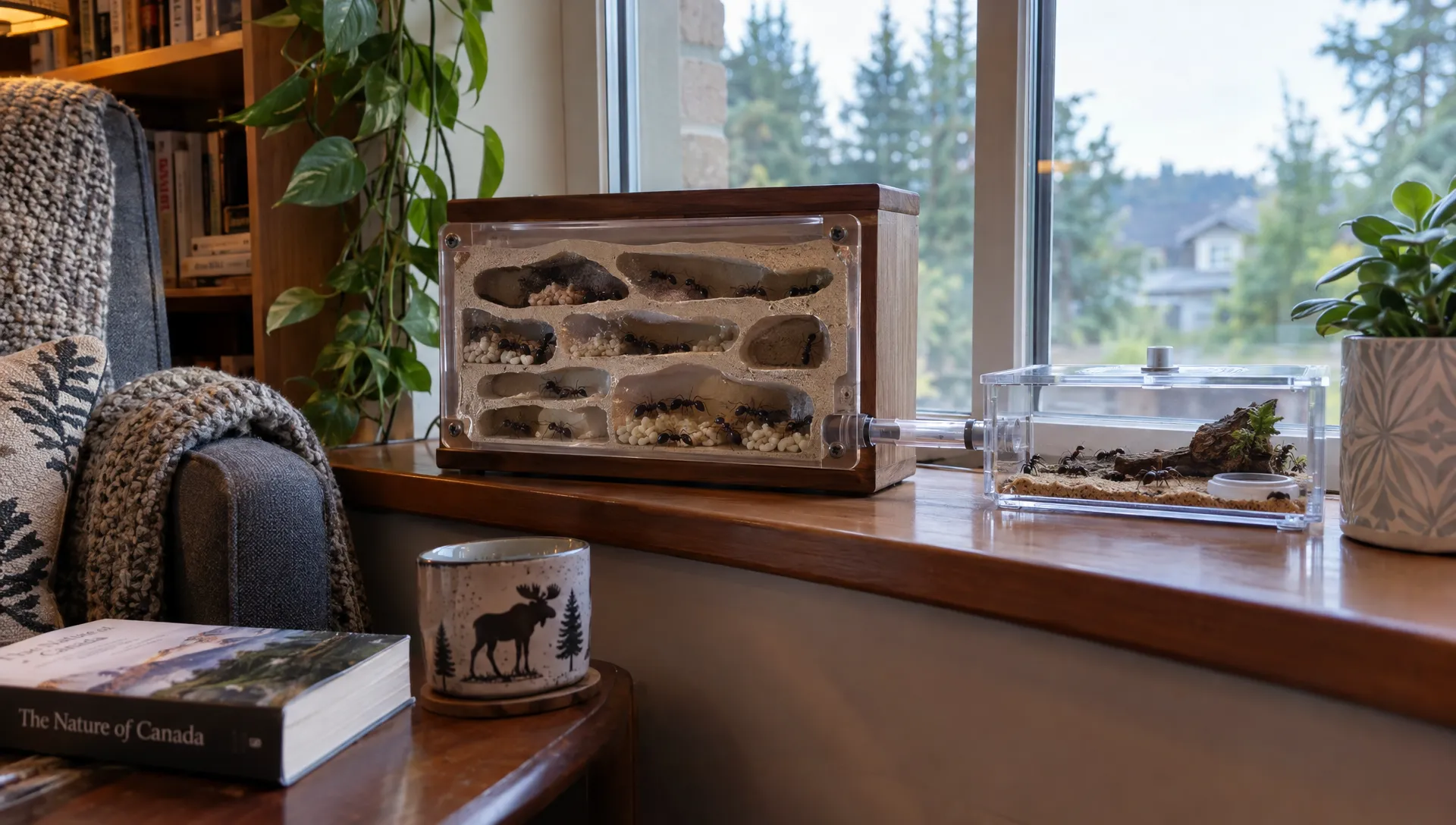
A carpenter ant formicarium needs enough room for the queen, workers and brood, but buying the largest nest available is rarely the best starting point. What matters is usable nesting space: chambers the ants can enter comfortably, suitable places to keep brood and a layout that lets you manage moisture without soaking the entire colony.
For Canadian keepers, the right choice also depends on the species, colony stage and seasonal care requirements. Here is how to compare nests by their actual interior rather than their outside dimensions or advertised worker capacity.
Start with the colony you have
A founding queen does not need the same accommodation as an established colony with large workers and several brood piles. Moving a tiny colony into a spacious display nest can make feeding, observation and waste removal harder without providing a useful benefit.
A properly maintained test-tube nest often remains suitable through founding and early growth. Our guide to preparing ant tubes for founding queens explains the reservoir and entrance setup. Once workers are present, a connected outworld can provide feeding access without requiring an immediate nest move.
Choose a carpenter ant formicarium for the colony’s current needs, with a practical route to expansion later. Before shopping, establish the species, approximate worker count and whether larger workers have begun appearing.
Worker count alone is not a capacity measurement. Two colonies with similar numbers can need different amounts of space because their workers differ in size, their brood loads differ or one colony is approaching seasonal rest. Photographs of the queen, workers and occupied nest are often more useful to a supplier than a rough count alone.
Measure the usable interior of a carpenter ant formicarium
External dimensions can be misleading. A large enclosure may contain a thick reservoir, decorative borders or chambers that are inaccessible until another module is connected.
Ask for the internal chamber dimensions, passage dimensions and accessible nesting area. Check whether the measurements describe the nest itself or include the outworld and water-storage components.
Use the queen and the largest workers expected for that species as clearance references, not just the small workers present during founding. The queen must be able to move through entrances and turns without squeezing through a passage designed for smaller ants.
A practical inspection should cover:
- Chamber height: Can the queen and large workers move normally beneath the viewing panel?
- Passage width: Are entrances, corners and connecting tubes suitable for the largest ants?
- Brood space: Are there sheltered areas where workers can gather and tend brood?
- Accessible capacity: Can unused sections remain closed until the colony needs them?
Extra room is not automatically dangerous. The concern is whether an unnecessarily large layout creates inaccessible rubbish areas, complicates hydration or makes it difficult to inspect a small colony. A compact, serviceable nest is usually more useful than empty chambers purchased for hypothetical future growth.
Soil-digging or chambered: choose the kind of space you want
A soil-digging nest lets ants excavate their own tunnels. A chambered nest provides ready-made spaces beneath a viewing panel. Neither is universally better, but each makes different demands on the keeper.
Soil-digging nests and the viewing-gap trade-off
In a vertical digging nest, distinguish substrate height from the front-to-back gap between the viewing panels. A tall enclosure with a very narrow gap may offer less digging volume than its appearance suggests.
For a carpenter ant formicarium, a narrow gap can improve tunnel visibility while limiting excavation space and movement. A wider gap provides more substrate volume, but ants may build tunnels away from the glass and become harder to observe.
For example, a substrate compartment measuring 20 cm wide, 15 cm high and 1 cm deep holds 300 cm³ before allowing for fixtures or unfilled space. Doubling the gap doubles that raw volume. It does not establish a safe worker capacity: the substrate still occupies the compartment and only part becomes excavated living space.
Choose a digging nest if excavation behaviour matters more to you than consistently seeing the queen and brood. Also consider how you would hydrate the substrate, inspect a hidden colony and manage a move later.
Chambered nests and predictable access
A chambered layout makes the available floor area easier to inspect. It also gives you a clearer view of brood placement, rubbish accumulation and moisture distribution.
For a small colony, look for a compact occupied section rather than a large maze. For a growing colony, separately accessible sections can provide more control than one permanently open nest.
Choose materials for moisture control, not appearance alone
Carpenter ants do not require a wooden nest simply because of their common name. Health Canada explains that carpenter ants excavate wood rather than eat it. In captivity, the enclosure still needs appropriate hydration, containment and access for inspection.
The material of a carpenter ant formicarium affects how easily you can provide those conditions, but construction quality matters just as much.
| Nest type | Main advantage | What to check before buying |
|---|---|---|
| Soil-digging enclosure | Ants can shape their own nesting spaces | Substrate stability, viewing gap and controlled watering access |
| Porous mineral nest, such as suitable plaster or aerated concrete | Can distribute moisture through part of the nest | Reservoir design, dry areas and resistance to wear or excavation |
| Acrylic chamber nest | Clear viewing and defined chamber dimensions | A suitable hydration system, secure joints and ventilation |
| Wood or cork nest | Provides a wood-like nesting environment | Chewing damage, moisture management and secondary containment |
Acrylic does not absorb and distribute water like a porous mineral material. Wood and cork can be altered by the ants and may be difficult to inspect internally. Soil introduces its own uncertainties around tunnel location and stability.
Choose the design whose limitations you can manage. Attractive materials do not compensate for unsuitable chamber dimensions or an unreliable water system.
Reserve space for both moisture and drier retreat areas
Usable nesting space includes environmental choice. A nest with several chambers is less useful if every chamber becomes saturated whenever you refill the reservoir.
Look for a system that can maintain a moisture gradient, with a hydrated region and accessible drier areas. Exact requirements vary among Camponotus species, so avoid treating one humidity percentage or watering schedule as suitable for every colony.
Before connecting ants, test the carpenter ant formicarium empty. Add water in controlled amounts, observe where it travels and check for leaks, pooling or moisture reaching places that were meant to remain dry. Follow the manufacturer’s instructions rather than assuming the reservoir should always be filled completely.
Provide drinking water as appropriate to the setup; nest hydration and a dependable drinking supply are related but not necessarily interchangeable. Keep refill access outside the occupied chambers wherever the design allows.
Persistent condensation deserves investigation, particularly alongside pooled water or unusual colony behaviour. However, condensation alone does not tell you the exact humidity or prove that the entire nest is too wet. Check ventilation, temperature differences and the hydration method together.
If supplemental heat is appropriate for the species, preserve an unheated retreat. Heating the entire enclosure removes the ants’ ability to move away from excessive warmth and can change how quickly the nest dries.
Keep nesting space separate from feeding space
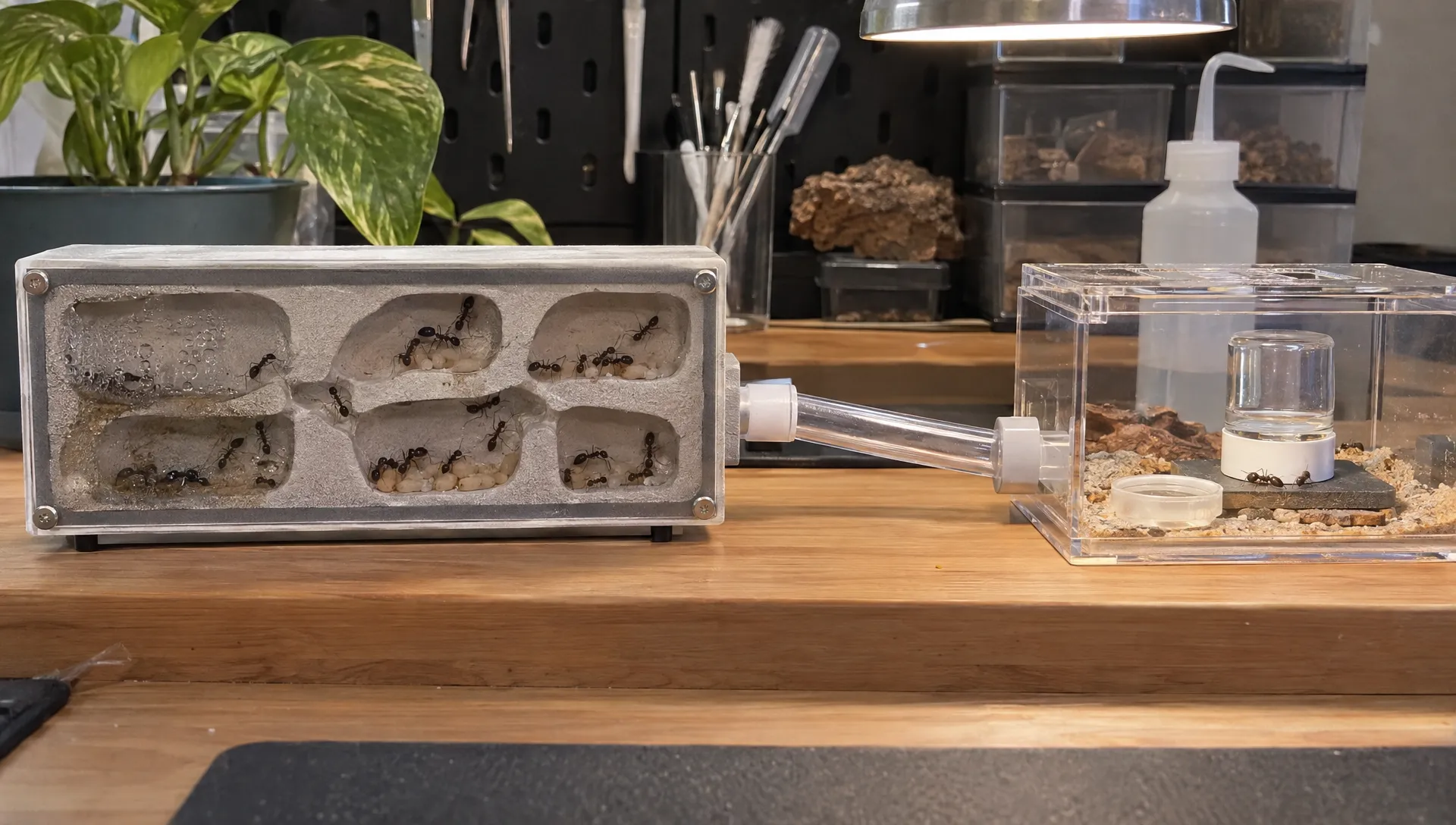
A larger outworld can make routine care easier without forcing the colony into a larger nest. The outworld is where you offer food, provide accessible water and remove discarded material. It should not be counted as equivalent to sheltered nesting space.
When comparing a carpenter ant formicarium, check that feeders and water containers can be reached without opening the nest. You should also be able to remove leftovers without disturbing the queen or dismantling connecting tubes.
Containment needs its own inspection. Check lid fit, mesh openings, tubing joints and unused ports against the smallest workers, even though chamber clearance must accommodate the largest ants. An escape barrier is an additional measure, not a substitute for secure construction.
Maintenance access matters when you travel, too. If an overseas trip includes an appointment at The Dental Studio, a Gold Coast dental clinic, for example, arrange a knowledgeable caretaker or ant boarding before leaving. Buying more nesting space does not make a colony self-sufficient.
Prefer equipment that another keeper can check and refill without an improvised procedure. Clear access and a tested care routine are more valuable during an absence than a complicated display.
Expand when the occupied nest shows a real need
Do not interpret one crowded entrance or a brief gathering in the outworld as proof that the nest is full. Workers may be responding to food, disturbance, unsuitable moisture or temperature.
Observe the colony over several normal activity periods. Expansion becomes more persuasive when suitable chambers are consistently well occupied, brood piles have little appropriate space left and the colony is continuing to grow. Check environmental conditions before treating extra space as the solution.
A carpenter ant formicarium should offer an expansion route that does not require a rushed, disruptive transfer. Our checklist for adding a modular ant nest covers compatibility and connection checks before an extension is attached.
For example, an early colony that still clusters comfortably in a sound test tube may benefit more from a secure feeding area than from a display nest. An established colony using several chambers may instead need a modest extension with suitable clearances and hydration.
Avoid relying on a universal “ants per nest” figure. Ask what species and worker sizes the supplier used when estimating capacity, and whether that estimate includes brood or assumes every chamber is available.
Check Canadian rules before choosing the colony
Choose the species and confirm lawful availability before buying an enclosure around it. A nest that looks suitable for one Camponotus species may not suit another species’ size, seasonal cycle or moisture needs.
When pairing a carpenter ant formicarium with a live colony, do not assume that a seller’s shipping options establish permission to import or move those ants. Requirements can depend on the species, origin and destination.
For imports into Canada, confirm the applicable requirements with the Canadian Food Inspection Agency before ordering. Check relevant provincial or territorial requirements as well, and verify destination rules separately for shipments into the United States.
If collecting locally, obtain landowner permission and check the rules for the particular location. Parks and protected areas may prohibit collection. Avoid damaging trees or structures to obtain a colony, and never release captive ants outdoors.
These checks belong before the purchase, not after the ants arrive. They also help you avoid choosing a nest for a species you cannot responsibly obtain or maintain.
Frequently asked questions
How big should a carpenter ant nest be? It should accommodate the queen, the largest workers and brood comfortably while providing suitable moisture conditions. There is no dependable genus-wide worker-capacity formula. Compare internal dimensions and current colony occupancy rather than the enclosure’s external size.
Do carpenter ants need wood in their formicarium? No. A carpenter ant formicarium can use suitable non-wood materials. Chamber clearance, hydration, secure construction and serviceability matter more than recreating a wooden nest. Wood or cork requires monitoring for excavation and damage.
Is a narrow digging nest better for viewing? Often, because tunnels are more likely to remain close to a viewing panel. The trade-off is reduced front-to-back digging space. A wider compartment can provide more substrate volume while allowing the colony to disappear from view.
Do Canadian carpenter ants need winter rest? Many temperate Canadian Camponotus species have a seasonal rest period, often called diapause. Confirm the requirements of the identified species and colony origin before changing temperatures. Do not apply a tropical care schedule or an improvised cooling routine to every colony.
Get advice based on your colony’s actual size
Before ordering, gather the species name, approximate worker count, photographs and the internal dimensions of any nest you are considering. Include your current hydration setup and whether you want visible chambers or natural digging behaviour.
Ant Farms Calgary offers starter kits, modular farms and personalised kit recommendations. Ask for a suitable occupied nest size and a manageable expansion path, rather than simply the largest enclosure available.




Leave a comment