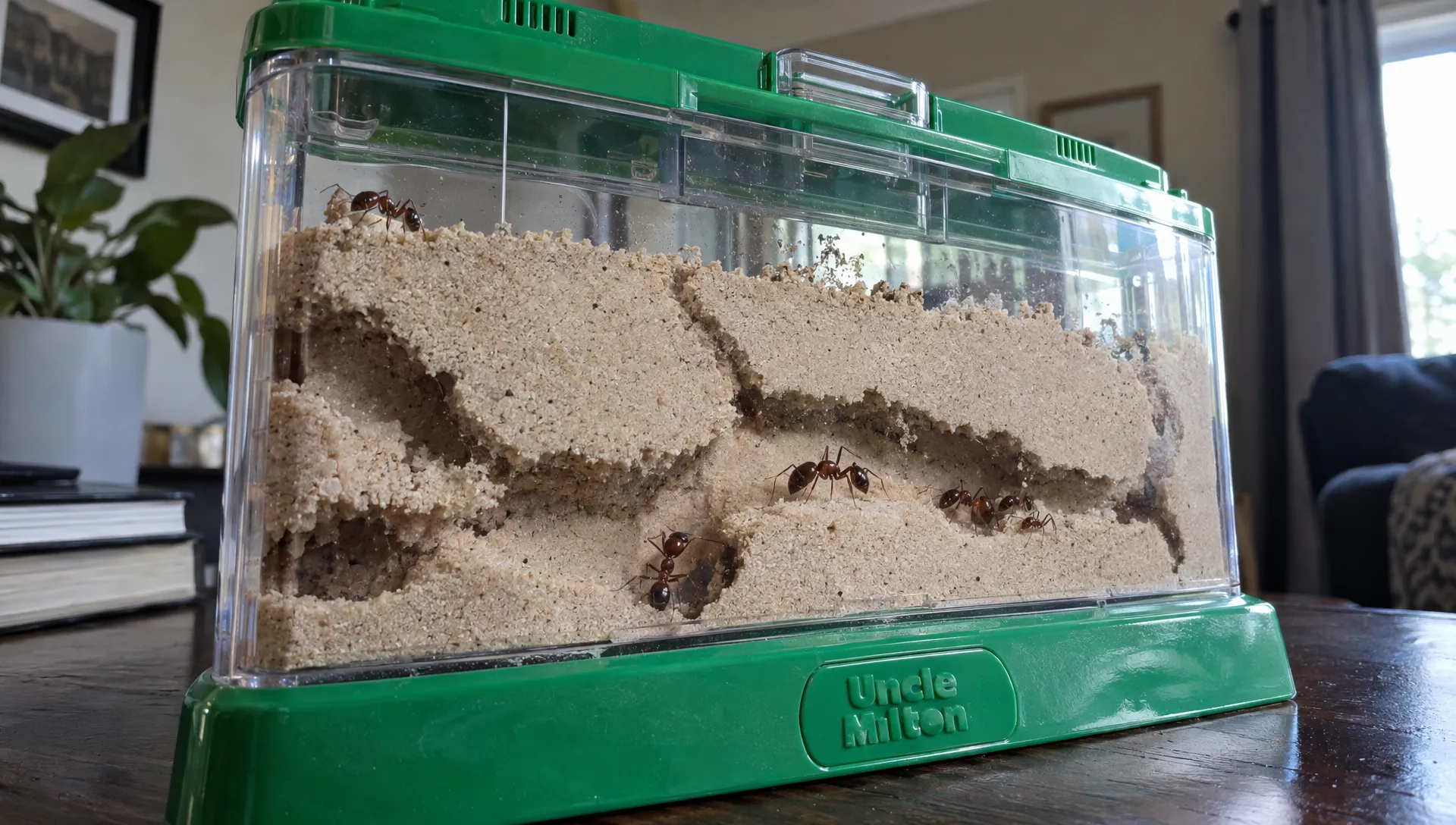
Choosing ants for Uncle Milton Ant Farm kits starts with the exact habitat model, the ants’ species and your delivery location. A packet labelled “live ants” is not enough: the workers must be large enough to stay inside, suited to the enclosure and legal to obtain where you live.
For many traditional sand-filled models, western harvester ants are the familiar choice, but they are not an automatic recommendation for every kit or Canadian address. Before ordering, establish whether you want a short-term worker-observation project or a growing colony with a queen. Those require different setups.
Start with the species and the purpose of the kit
Western harvester ants (Pogonomyrmex occidentalis) have historically been supplied for traditional Uncle Milton sand habitats. Their relatively large workers are easy to observe as they excavate tunnels. However, they can sting, so adults should manage transfers and children should observe through the closed enclosure. They are unsuitable for direct handling.
Do not substitute another species simply because a seller calls it a “harvester ant”. Common names can cover different species with different sizes, care requirements and legal restrictions. Ask for the scientific name and confirmation that the workers suit your particular model.
The best ants for Uncle Milton Ant Farm habitats must also match your expectations. A worker-only group can dig, forage and interact, but it cannot replace itself with new workers. Expect a temporary observation project, often lasting weeks to a few months rather than years, with considerable variation in survival.
A queenright colony, meaning one containing a reproductive queen, needs an appropriate nest, feeding area and longer-term care plan. Do not add a queen to a narrow display habitat without species-specific advice.
Check the exact model, not just the brand
Find the model name or number on the box, instructions or moulded enclosure. Uncle Milton habitats differ, so instructions for a sand-filled farm should not automatically be applied to a gel model or another design.
Check these points before buying:
- Substrate: Use the filling specified for that model rather than garden soil or an improvised mixture.
- Containment: Ask whether the smallest supplied workers can pass through ventilation holes, lid gaps or connection ports.
- Capacity: Follow the model’s recommended worker quantity rather than adding extra ants for faster tunnelling.
- Care access: Confirm how food and water can be supplied without leaving the enclosure open.
As with matching Dr. Pen replacement cartridges to a device, a “replacement” label alone does not establish compatibility. With live animals, the check must cover their care needs as well as physical fit.
Buying ants for Uncle Milton Ant Farm habitats in Canada
Check any ant-ordering voucher included with your kit before spending money on replacement ants. A habitat being sold in Canada does not prove that its ant-fulfilment service delivers live insects to Canadian addresses.
Look for an explicit destination policy, the supplied species, seasonal restrictions and the seller’s live-arrival terms. If the redemption page does not clearly accept your Canadian address, ask the current fulfilment provider before paying. Do not assume an older instruction leaflet reflects today’s service.
A Canadian supplier may offer a more practical route, but domestic availability still does not establish model compatibility. Send the supplier photographs of the enclosure and its model number. Ask whether it supplies suitable workers, rather than assuming that a queenright colony can be divided or placed inside.
Our guide to choosing an ant shop with reliable care support explains how to assess species information, shipping arrangements and after-sales help.
Should you collect ants outdoors?
Local collection is not automatically the easiest or safest option. Small garden ants may escape through openings that contain larger workers, while unfamiliar species may sting, spray defensive chemicals or have care needs you cannot meet.
Start with clear photographs taken without handling the ants. Capture their shape, approximate size and nesting surroundings, then ask a knowledgeable local ant keeper or entomology group for identification. Colour alone is not reliable, and a photograph may not allow a confident species identification.
Collecting ants for Uncle Milton Ant Farm kits should only be considered after identification, permission from the landowner and a check of applicable collection rules. Avoid protected areas, pesticide-treated sites and unidentified stinging ants. Do not dig up a nest just to fill a display.
Never combine workers from different nests, even if they look alike. They may fight. If identification or containment remains uncertain, use a suitable supplier instead.
Prepare the enclosure before the ants arrive
Assemble the empty habitat according to its instructions. Check that the lid closes properly, ports are capped and the clear panels are undamaged. Put it on a stable surface away from direct sunlight, radiators, draughts and places where children or pets could knock it over.
For sand-filled models, follow the specified substrate quantity and moistening method. The aim is a diggable medium that supports tunnels, not saturated sand or standing water. Do not add fertiliser, fragranced products or soil from a treated garden.
Gel models need their own instructions. Do not assume they require the same added water or feeding routine as a sand habitat, or that a gel display is suitable for maintaining a breeding colony.
Keep decorations out of narrow tunnelling spaces unless the manufacturer permits them. Extra objects can obstruct access or make cleaning harder.
Before accepting delivery of ants for Uncle Milton Ant Farm kits, have the approved food, watering equipment and transfer instructions ready. You should not need to improvise while an open transport tube is in your hand.
Introduce the workers without rushing
On arrival, inspect the closed shipping container before opening it. Check for damage, escaped ants, excessive condensation and obvious casualties. Photograph any concerns while the packaging and labels are still available.
Let the sealed transport container reach a stable indoor temperature naturally, following the seller’s species-specific guidance. Do not put it on a radiator, under a lamp or in hot water. Likewise, do not refrigerate or freeze ants as a general transfer method.
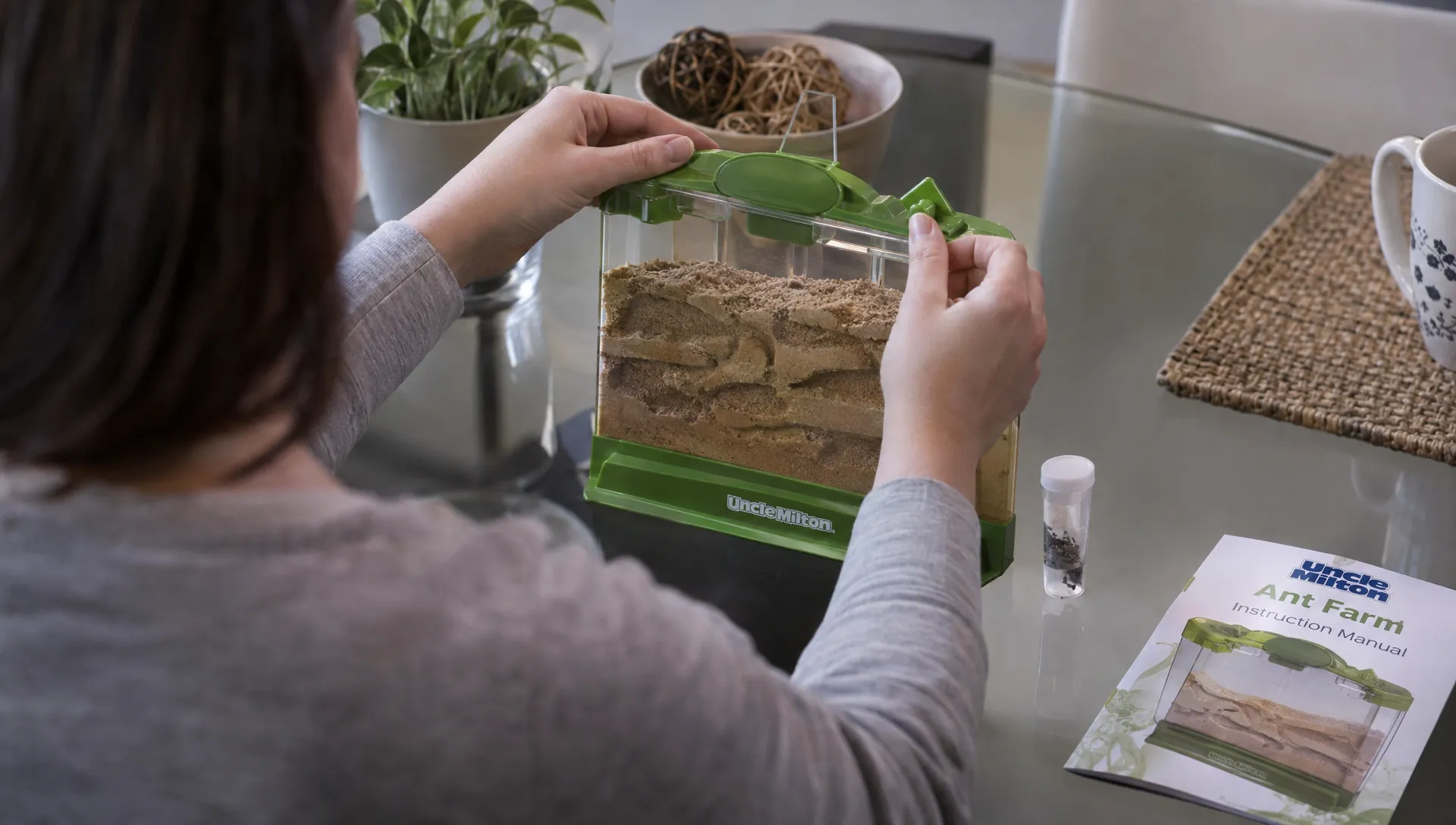
An adult should perform the transfer in a quiet area away from children and pets. Use the model’s designated opening and the supplier’s instructions, then secure the lid immediately. Do not handle stinging workers with bare fingers or shake the container to dislodge them.
Once introduced, leave the enclosure undisturbed. Repeated tapping, tilting and moving can stress the ants and collapse newly excavated tunnels. Immediate digging is not a reliable test of whether the group is healthy.
Feed and hydrate according to the species
A narrow display habitat leaves little room for feeding mistakes. Obtain a written care routine that covers food type, portion size, water delivery and removal of leftovers.
Harvester ants commonly use seeds, but that does not mean every seed mixture is suitable or that every ant species eats seeds. Follow the supplier’s recommendations for the identified species and the manufacturer’s instructions for delivering food inside the enclosure.
| Care need | Practical approach | Avoid |
|---|---|---|
| Water | Use the model-approved method and monitor substrate moisture | Open pools, flooding or unmeasured soaking |
| Food | Offer small, species-appropriate portions | Assuming all ants need the same diet |
| Cleanliness | Remove accessible leftovers before they spoil | Leaving wet food to develop mould |
| Temperature | Keep conditions stable within the species’ recommended range | Direct sunlight or improvised heating |
| Observation | Watch through the panels and minimise disturbance | Tapping the enclosure or repeatedly opening it |
When caring for ants for Uncle Milton Ant Farm habitats, remember that fewer visible workers do not necessarily mean escape. Some may be resting below the surface. Check the enclosure’s seals and observe over time rather than disturbing tunnels to count them.
Ask the supplier about persistent inactivity, widespread deaths or mould. Do not introduce additional workers to “refresh” the group, since unfamiliar ants may attack one another.
Plan for shipping conditions and arrival problems
Canadian weather can make live-ant deliveries difficult. Check the forecast at your address, along the likely route and around the dispatch date. A heat pack or insulated box does not make every temperature safe.
Confirm the dispatch schedule, expected transit time, delivery method and any weather-hold policy before ordering. Arrange to receive the parcel promptly rather than leaving it in an outdoor mailbox or on a doorstep. Local pickup may be worth considering when available.
If the ants arrive inactive, injured or dead
Cold-stressed ants may appear motionless, but inactivity alone does not establish that they are dead. Keep the container sealed in a stable indoor location and follow the seller’s recovery instructions. Do not use rapid heating, flood the container or force-feed unresponsive workers.
When ordering ants for Uncle Milton Ant Farm kits, read the live-arrival claim procedure in advance. If there is a problem, contact the seller promptly and provide the order number, delivery time, photographs and a description of the packaging condition. Keep the shipping materials until the seller advises otherwise.
If the container is broken or leaking ants, prioritise containment rather than transferring them casually. Keep children and pets away and ask the supplier how to proceed safely, especially if the species can sting.
Check Canadian import requirements before paying
Ordering live ants from another country is different from ordering an empty habitat. Requirements can depend on the scientific name, origin, destination and intended use.
Consult the Canadian Food Inspection Agency’s Automated Import Reference System and contact CFIA if the applicable requirements are unclear. Provincial or territorial restrictions may also need checking. A seller’s willingness to post a parcel is not proof that importing its contents is permitted.
Do not release purchased ants outdoors, including species you believe occur locally. Keep them securely contained and ask the supplier about appropriate end-of-life or rehoming arrangements if you cannot continue their care.
Frequently asked questions
What kind of ants does Uncle Milton use? Western harvester ants, Pogonomyrmex occidentalis, have traditionally been associated with many sand-filled Uncle Milton kits. Confirm the species supplied by the current fulfilment provider and its suitability for your exact model.
Can I order replacement ants from Uncle Milton in Canada? Only rely on the service if its current terms explicitly accept your Canadian destination and the shipment meets applicable requirements. Check the redemption page or contact the fulfilment provider before paying. Canadian retail availability of the empty kit does not confirm live-ant delivery.
Do ants for Uncle Milton Ant Farm kits come with a queen? Traditional replacement groups are generally workers without a queen. Verify the listing rather than assuming. A worker-only group is a temporary observation project, not a colony that will keep producing workers.
How many ants should I put in the farm? Use the quantity recommended for the exact model and species. More ants can increase crowding and make food, moisture and waste harder to manage.
Can I add ants from my garden to the existing group? No. Ants from different nests can fight, even when they appear to be the same species. Unknown garden ants may also escape or require different care.
Get advice before choosing your ants
Have your habitat’s model number, photographs and delivery location ready before purchasing. Ask Ant Farms Calgary about suitable ants, current availability and whether your enclosure matches your goals.
For a short observation project, focus on a compatible worker group and a clear care routine. For a colony you hope to maintain and expand, ask about an appropriate starter kit or modular habitat rather than adapting a narrow display farm without guidance.




Leave a comment