
If you have ever flipped over a rotting log in a Canadian forest and watched big, two toned ants pour out carrying their cocoons, there is a good chance you met Camponotus novaeboracensis, the New York carpenter ant. Despite the name, this species is just as much at home in Alberta as it is in New York. It is one of the most rewarding ants a beginner can keep: large enough to watch without a magnifier, calm, beautiful, and long lived.
This guide covers everything you need to know about this species, from where it lives and how it behaves in the wild to breeding, temperature, feeding and hibernation in an ant farm.
Quick facts
- Scientific name
- Camponotus novaeboracensis
- Common name
- New York carpenter ant
- Native range
- Northern United States and southern Canada, including Alberta
- Worker size
- About 6 to 12 mm (minor and major workers)
- Queen size
- About 15 to 17 mm
- Colour
- Black head and abdomen, red to orange thorax and legs
- Queens per colony
- One (monogyne)
- Colony founding
- Claustral, the queen raises her first workers alone without food
- Ideal temperature
- 22 to 27 °C in the active season
- Hibernation
- Yes, about 3 to 4 months at 5 to 10 °C
- Diet
- Sugars (honey water, sugar water) and insects
- Growth speed
- Slow in the first year, steady after that
- Difficulty
- Beginner friendly
How to identify the New York carpenter ant
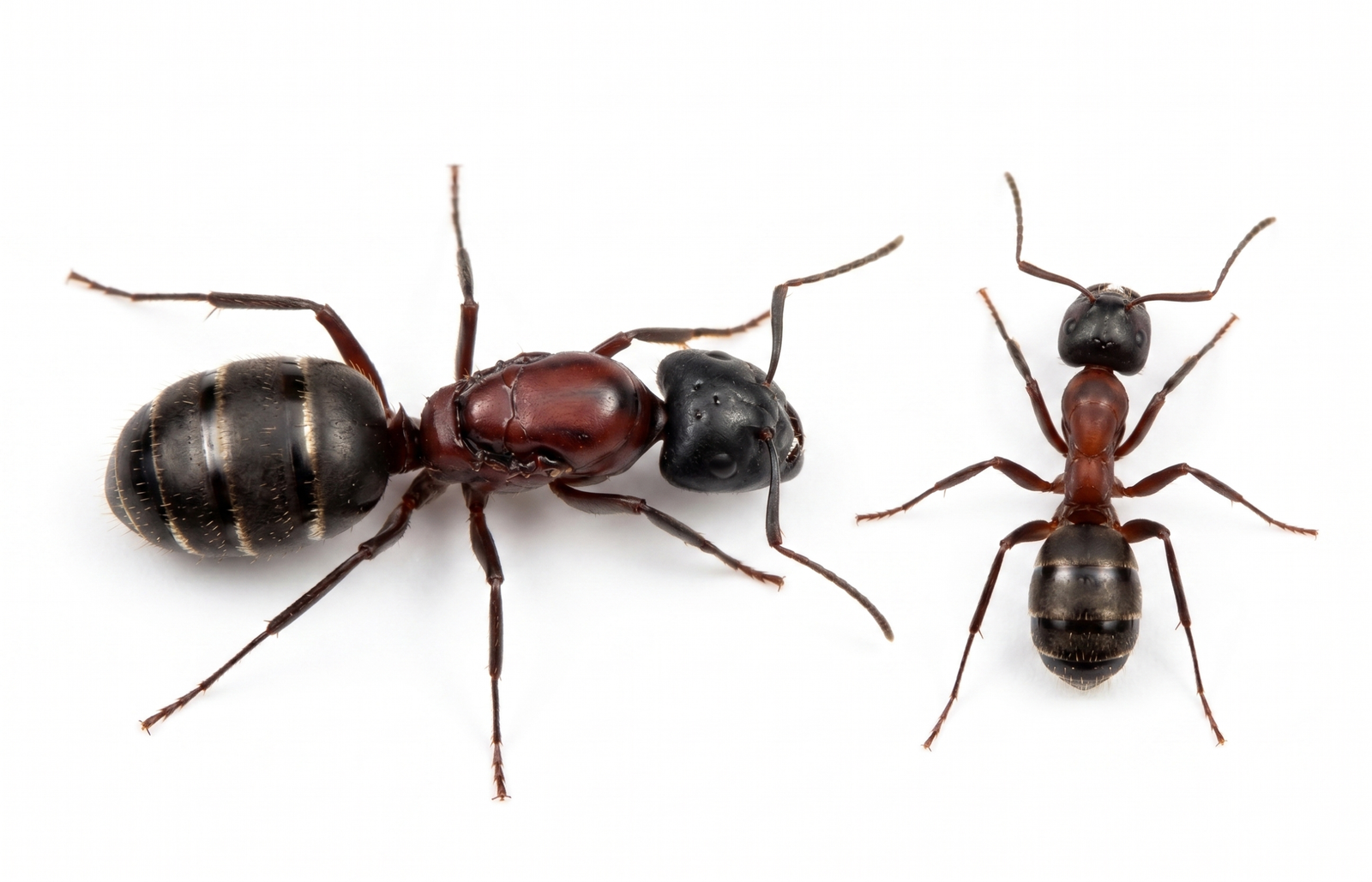
The easiest way to recognize this species is its colour pattern. The head and the abdomen (called the gaster) are black, while the middle section (the thorax) and the legs are a warm red to orange brown. In bright light the gaster often shows a soft golden shine from fine hairs.
Workers come in different sizes, which is called polymorphism. Small workers, called minors, do most of the everyday jobs like caring for brood and collecting food. Larger workers, called majors, have big heads and powerful jaws and are the colony’s heavy lifters and defenders. Queens are much larger than workers and have a thick, muscular thorax that once powered their wings.
- Minor workers: about 6 to 8 mm, slender, very active
- Major workers: up to about 12 mm, with an oversized head
- Queen: about 15 to 17 mm, with a large thorax and wing scars after she sheds her wings
- Males: smaller, slim and winged, only produced by mature colonies
A close look alike is Camponotus pennsylvanicus, the black carpenter ant, which is almost completely black. If the thorax is clearly red or orange, you are most likely looking at C. novaeboracensis.
Where they live
New York carpenter ants live across the northern United States and much of southern Canada. They are a forest species and do best in cool, wooded areas with plenty of dead wood.
In the wild they nest in:
- Fallen logs and old stumps
- Dead branches and standing dead trees
- Under loose bark
- Under rocks at the edge of forests
- Occasionally in damp or damaged wood in sheds, decks and cabins
Carpenter ants do not eat wood. They chew tunnels and chambers into wood that is already soft or rotting, and push the sawdust out of the nest. This is how they get their name.
Behaviour and colony life
This is a calm and easygoing species. Workers move with purpose but are rarely aggressive toward people. In the wild they do much of their foraging in the evening and at night, following scent trails to aphid colonies, flowers and dead insects. In an ant farm you will often see them most active when the room is quiet and dim.
Colonies are well organized. Younger workers stay inside to look after the queen, eggs, larvae and cocoons. Older workers take on the riskier jobs outside the nest, like foraging and guarding the entrance. Majors usually stay close to the nest and step in when something heavy needs moving or the colony needs defending.
Some behaviours you can watch for in your farm:
- Trophallaxis: workers sharing liquid food mouth to mouth. This is how food spreads through the whole colony.
- Brood sorting: workers constantly move eggs, larvae and cocoons to the spots with the best temperature and moisture.
- Waste management: carpenter ants keep a tidy nest and carry leftovers and waste to one corner of the outworld, often called the midden.
- Defence: when disturbed, workers raise their abdomen and can spray a small amount of formic acid. It smells sharp but is harmless to people.
Carpenter ants can bite if handled, but the bite is only a light pinch. They have no stinger. Simply avoid touching them and they will leave you alone.
Breeding and life cycle
Nuptial flights
Mature colonies raise winged queens and males in late summer. These winged ants usually stay in the nest through winter and leave on a mating flight the next spring or early summer, typically on a warm, humid evening after rain. After mating in the air, the queen lands, breaks off her wings and searches for a safe place to start her colony.
Founding a new colony
This species founds its colonies claustrally. The queen seals herself into a small chamber and does not leave or eat. She lives off the fat reserves in her body and the now useless wing muscles in her thorax, and uses that energy to raise her first small group of workers.
From egg to worker
- Eggs: tiny, white and laid in small clumps
- Larvae: white, grub like and fed by the queen or workers
- Pupae: carpenter ant larvae spin a tan, silk cocoon before turning into adults
- Workers: the first workers, called nanitics, are smaller than normal workers
At warm temperatures, development from egg to adult worker takes around 6 to 10 weeks. Cooler temperatures slow it down. A colony usually has only a handful to a couple dozen workers by the end of its first season.
How big and how long
Growth is slow in the first year and speeds up as the worker force grows. Once the colony reaches the hundreds, it begins producing large major workers. A mature colony can have a few thousand workers after several years. Carpenter ant queens are long lived and, with good care, can live for well over a decade, so this is a pet colony that can be with you for many years.
Temperature and humidity
New York carpenter ants are comfortable at normal room temperature, which makes them easy to keep in a Canadian home.
- Active season: 22 to 27 °C is ideal. Brood grows fastest at the warmer end of that range.
- Avoid: temperatures above 30 °C and direct sunlight on the farm. Sunlight can overheat a small nest very quickly.
- Humidity: give the nest a moisture gradient, with one area slightly damp and another area drier. The ants will place their brood where conditions are best.
- Outworld: keep the arena mostly dry. A small water source is all they need there.
If you see condensation on the inside of the nest, you are adding too much water. The nest should feel slightly moist, never wet.
Hibernation
This species comes from a cold climate and needs a winter rest, called diapause or hibernation, to stay healthy. Without it, the queen may lay fewer eggs and the colony can weaken over time.
- When: roughly from late fall to early spring, about 3 to 4 months
- Temperature: about 5 to 10 °C, for example in a wine fridge, cool basement or garage that does not freeze
- How to start: lower the temperature gradually over one to two weeks and stop feeding protein a few weeks before
- During hibernation: the ants barely move. Check every few weeks that the water source has not dried out
- Waking up: warm them back up slowly over a week or two, then offer sugar first and protein a few days later
You will often notice the colony slowing down on its own in the fall, even at room temperature. That is your signal that it is time.
Feeding
Like most ants, carpenter ants need two kinds of food: sugar for energy and protein for growing brood.
Sugars
- Honey water or sugar water, offered in a small dish or on a cotton ball
- Small pieces of soft fruit, removed before they go mouldy
Protein
- Fruit flies for small colonies
- Cut up crickets, mealworms or roaches for bigger colonies
- Feeder insects should be pre killed and from a clean source. Avoid wild insects that may carry pesticides
Feed protein about twice a week and remove leftovers after about 12 hours so they do not cause mould. A founding queen with no workers does not need food at all. Once the first workers arrive, start with very small amounts.
Keeping them in an ant farm
Your colony will arrive in a test tube, which is the perfect starter home. Most colonies can stay in their test tube for 5 to 6 weeks after arrival. Keep it in a dark, quiet place and connect it to an outworld so the workers can forage.
Move the colony into a proper nest once it has around 15 to 30 workers or the test tube water is running low. A small nest is better than a huge one at first, because ants feel safer in tight, dark spaces. As the colony grows, a modular farm lets you add new sections instead of buying a whole new setup.
Good first homes for this species:
- Modular Ant Farm New Gen Small kit for young colonies
- Modular Farm 2XL kit for a growing colony
- Modular Farm 3XV kit for an established colony with majors
Do not rush the move. If the ants are not moving into the new nest, cover it to make it dark and let the test tube slowly dry out. They will move when they are ready.
Watch them in action
Here is a beautiful look at New York carpenter ants in their natural habitat. Notice the red thorax and the size difference between workers.
Start your own carpenter ant colony
Our Camponotus novaeboracensis colonies come with a queen, workers and eggs, raised by experienced keepers in Calgary and covered by our Live Arrival Guarantee.
Frequently asked questions
Are New York carpenter ants good for beginners?
Yes. They are calm, large, easy to watch and do well at room temperature. Their only real need is a yearly hibernation, which is easy to provide.
How fast does a Camponotus novaeboracensis colony grow?
Slowly at first. Expect a small number of workers in the first year. Growth speeds up in the second and third years once the colony has a strong worker force.
Do New York carpenter ants need to hibernate?
Yes. Give them about 3 to 4 months at 5 to 10 °C each winter. Skipping hibernation can weaken the queen and the colony.
Do carpenter ants sting?
No. They have no stinger. They can give a light pinch with their jaws and may spray a little formic acid, but they are harmless to people.
Will carpenter ants damage my house?
Not from an ant farm. A pet colony lives in a closed farm and cannot reach your home. In the wild they only nest in wood that is already wet or rotting.
How long does a carpenter ant queen live?
Carpenter ant queens are some of the longest lived insects. With good care a queen can live for well over a decade.