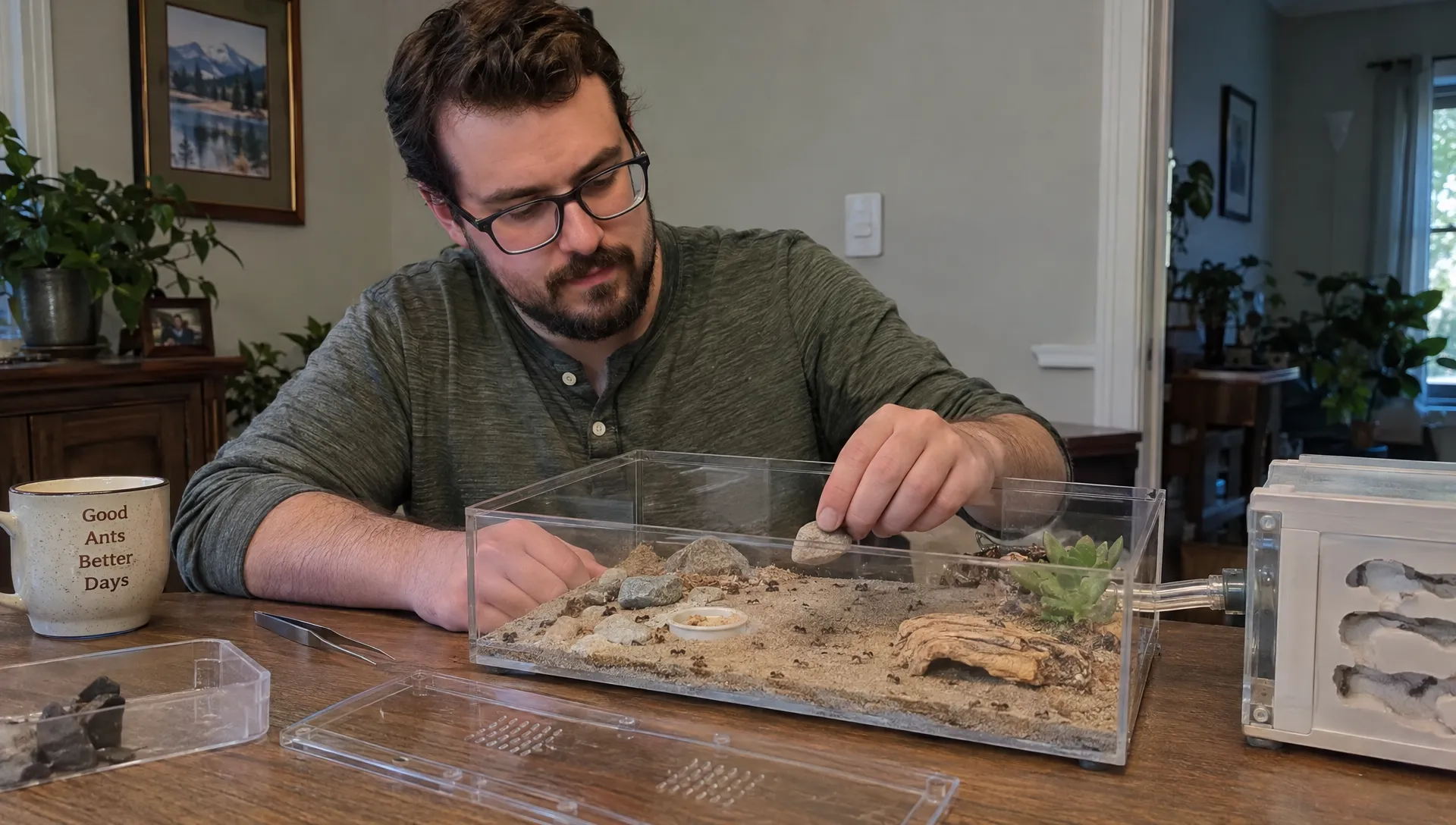
The best ant farm decorations are stable, removable and simple to inspect. They should make the outworld interesting without hiding leftover food, blocking the nest entrance or giving workers a route around an escape barrier. A plain stone that lifts out easily is often a better choice than an elaborate miniature landscape with inaccessible gaps.
Start with the colony’s needs, then choose the scenery. This guide explains which materials deserve consideration, what to avoid and how to decorate without turning routine cleaning into a disturbance.
Decorate the outworld, not the working nest
The outworld is the area where ants forage and where you usually provide food. The nest contains the chambers used by the queen, brood and resting workers. These spaces have different requirements.
Most decorative additions belong in the outworld. Putting objects into nest chambers can interfere with hydration, reduce usable space or make brood difficult to observe. Leave the nest’s internal layout alone unless the manufacturer specifically designed it for adjustable inserts.
Even in the outworld, an object can become an unintended nesting site. A hollow ornament, deep substrate or damp piece of cork may attract workers carrying brood. That makes removal much harder.
Before adding scenery, check that the enclosure already provides appropriate ventilation, water and escape prevention. Our guide to creating a safe indoor home for ants explains those essentials.
Choose ant farm decorations by material, not appearance
No material is automatically safe just because a shop labels it “natural”, “non-toxic” or “aquarium-style”. Those descriptions do not establish suitability for a particular ant species or enclosure.
Prefer items with a known composition, a traceable supplier and surfaces you can inspect. Use this table as a screening tool, not a guarantee of safety.
| Material | What to look for | Main cleaning or safety concern |
|---|---|---|
| Solid stone | A clean, non-crumbling piece with no sharp edges | Heavy pieces can shift; rough surfaces trap waste |
| Glass | A smooth, intact object that sits securely | Chips, breakage and unstable shapes |
| Glazed ceramic | A known, intact glaze with no flaking decoration | Cracks and cavities can retain dirty water |
| Untreated cork or wood | Known origin, no preservatives and accessible surfaces | Moisture retention, mould and hidden insects |
| Plastic plants or ornaments | Identified material with no loose coatings or sharp seams | Unknown additives, peeling finishes and inaccessible joins |
| Resin ornaments | Clear information about the finished product and intended use | Incomplete curing, coatings and hollow interiors |
Be cautious with paints, glues and coatings
For ant farm decorations, a washable surface is useful only if the underlying material and finish are suitable too. Craft paint, varnish, glitter and flocking can shed particles or introduce substances whose effects on ants are unknown.
“Food-safe” and “non-toxic” claims have specific testing contexts. Neither automatically means suitable for continuous exposure in a warm, humid insect enclosure.
Avoid using construction adhesives, fresh epoxy or sealants inside an occupied farm. Some silicone products contain mould inhibitors, while other adhesives release substances during curing. A fully cured product is not necessarily appropriate for ants either. Check the exact product with the habitat supplier rather than relying on a broad material name.
A piece that stands securely without adhesive is usually the simplest option. Never use ants to test an uncertain material, and do not assume that an absence of smell proves safety.
Plan a layout you can clean without dismantling
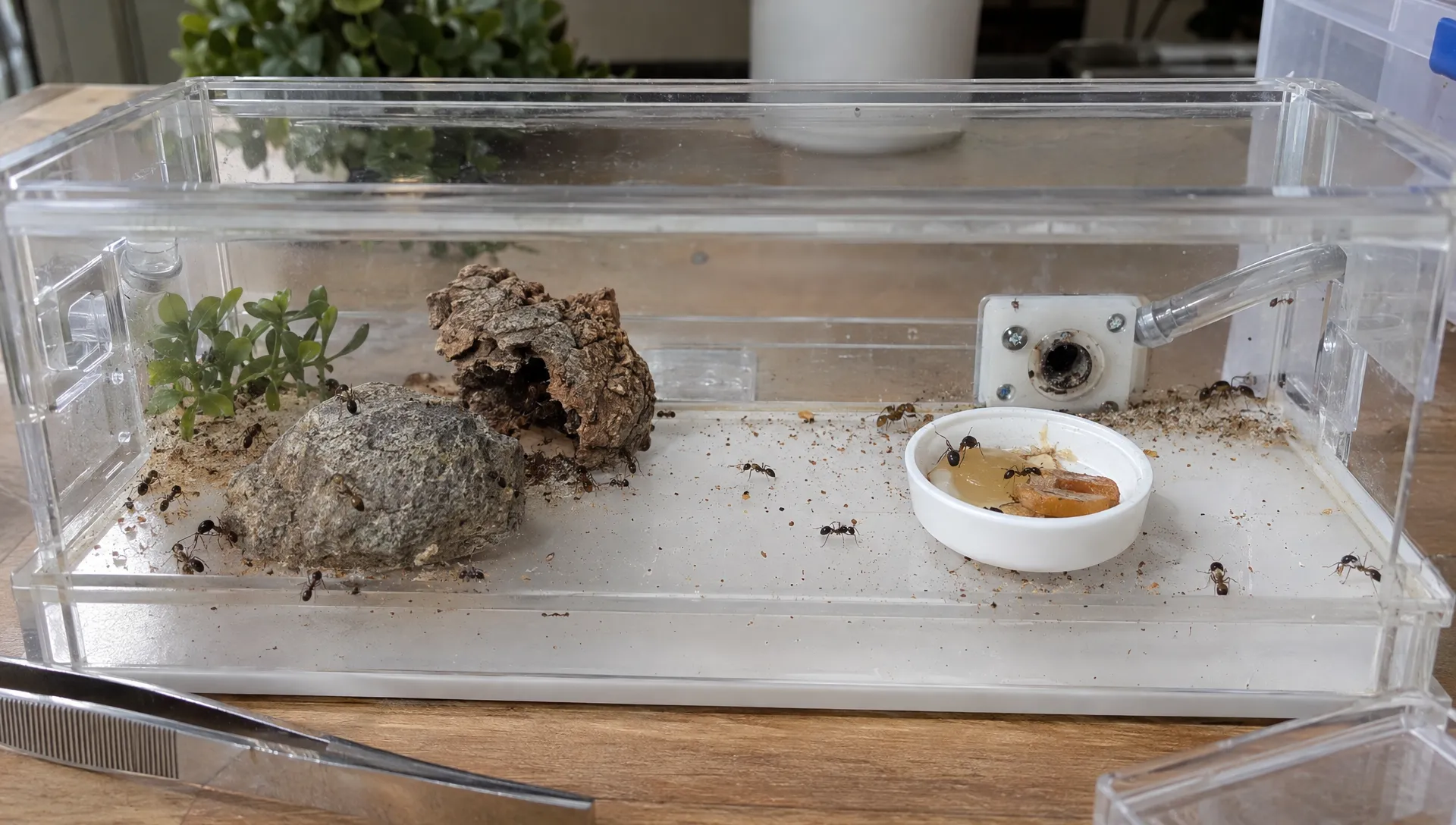
A useful arrangement leaves the feeding area, water source and nest entrance visible. You should be able to reach discarded food with tweezers without lifting several other objects first.
Choose one or two substantial features rather than filling every corner. Position taller pieces towards the back if that preserves your viewing angle, but check clearance from the lid and escape barrier on every side.
When arranging ant farm decorations, assess the enclosure from an ant’s route rather than your viewing position. A twig leaning against a wall can bypass a barrier, and loose grains may accumulate on a treated surface. Keep ornaments away from barrier bands, ventilation openings, ports and lid seams.
Check stability and hidden spaces
Test the layout in an empty enclosure or a matching container before installation. Each object should remain stable during the small movements involved in feeding and maintenance. Do not balance stones on loose substrate or rely on fragile branches to hold a heavy feature.
Avoid narrow crevices you cannot inspect. An opening that admits workers but prevents you from seeing inside can conceal food, waste or resting ants. Hollow ornaments are particularly awkward if their interiors cannot be reached with a brush.
Substrate is optional in many manufactured outworlds. Where appropriate for the species and setup, a thin, removable layer is easier to inspect than a deep decorative bed. Follow the enclosure supplier’s guidance rather than adding soil simply to make the scene look natural.
Choose natural and DIY pieces carefully
Found materials are inexpensive, but their history is often unknown. A branch from an untreated garden is different from landscaping wood exposed to preservatives, pesticides or fertiliser.
For DIY ant farm decorations, start with a simple shape: one stable stone or a small, untreated cork piece with no concealed cavity. Avoid complicated assemblies that need paint, glue or multiple fasteners.
In Canada, avoid collecting near roads, salted walkways, sprayed lawns or treated building materials. Obtain permission where necessary and check local restrictions before taking anything from parks or protected areas. Reject items with mould, sap, crumbling surfaces or signs of other insects.
Cleaning does not remove every risk
Rinsing can remove loose dirt, but it cannot reliably remove absorbed pesticides or preservatives. Freezing outdoor wood does not establish that it is free of pests, microbes or chemical contamination. Boiling or baking is not a universal solution either, and heating stones or unknown materials can be hazardous.
When the source is uncertain, leave the item out. Purpose-sourced habitat materials reduce uncertainty about origin, although they still need inspection and suitability checks.
Winter collection deserves the same caution as summer collection. Snow cover does not make roadside materials clean. Indoors, condensation or damp contact points can still support mould even when heated room air feels dry.
Ant Farms Calgary’s introduction to natural HardScape landscapes offers another way to explore natural scenery without treating every found branch as suitable habitat material.
Install pieces without disturbing the colony
Prepare and inspect everything outside the enclosure first. Rinse suitable washable items with clean water, check their undersides and allow them to dry before installation. Keep the lid open only as long as needed, maintaining the enclosure’s normal escape precautions.
Introduce ant farm decorations one piece at a time. Use long tweezers where practical, move slowly and check the placement area for workers before lowering an object. Never set a heavy piece down on ants or push it into an occupied corner.
Do not put new scenery directly against the nest entrance. Workers need room to pass, carry food and remove waste. Keep feeding dishes accessible so maintenance does not require moving the entire scene.
After installation, watch for shifting pieces, trapped workers or ants using the new feature to approach an escape route. Increased exploration can occur after a change, but brood being carried into an ornament is a reason to reassess the design. Do not pull apart a newly occupied hiding place abruptly.
If your colony has a species-specific winter rest period, avoid unnecessary redesigns during that time. Ask your supplier about timing rather than assuming all species follow the same seasonal schedule.
Clean according to the material and the mess
Inspect the outworld during feeding and remove accessible food remains before they deteriorate. A sticky patch of sugar solution needs attention sooner than a clean, dry stone. There is no single cleaning interval that suits every colony, food type and humidity level.
The easiest ant farm decorations to maintain are those you can lift out individually after checking for workers. Before removal, inspect every accessible side and allow ants to walk off. Do not shake an occupied ornament over a sink or carry it away with hidden workers inside.
Use the least complicated cleaning method
For suitable non-porous pieces, a dedicated soft brush and clean water are a sensible starting point. Rinse thoroughly and let the piece dry before returning it. Keep ant-care brushes separate from household cleaning equipment.
Avoid fragranced cleaners, furniture polish and household sprays around the enclosure. If contamination requires a disinfectant or detergent, get material-specific guidance from the supplier and clean the item away from the colony. Do not return anything that may retain residue.
Porous wood and cork are harder to clean thoroughly. If a piece develops persistent mould, absorbs spoiled food or becomes impossible to inspect, replacement may be more practical than repeated scrubbing. Also investigate the cause, such as a leaking water source or food trapped underneath.
Remove one feature at a time where possible. Routine outworld maintenance should not require dismantling the nest or forcing the colony to relocate.
Keep gift-display props outside
Unverified craft scenery can decorate the shelf around the farm instead of going inside it. Keep props clear of ventilation and away from openings during maintenance. For a proposal-themed gift, a guide to buying an engagement ring in New Zealand can help with the jewellery choice; the ring and its presentation box belong beside the closed enclosure, not in the ants’ habitat.
Frequently asked questions
Can I use decorations from an aquarium or craft shop? Possibly, but the shop category is not proof of suitability. Check the material, coating, cavities and cleaning requirements. Aquarium products may be designed for submerged use rather than a dry outworld, while craft items often have unidentified finishes. Ask the supplier about the exact item.
Do different species need different ant farm decorations? Species differ in worker size, climbing ability, moisture requirements and nesting behaviour. Tiny workers can enter gaps that larger ants cannot, while some colonies readily occupy sheltered, damp spaces. Choose features around those behaviours rather than a particular visual theme.
Are artificial plants easier to clean than real plants? A simple artificial plant may be easier to remove and wash, provided its material and finish are suitable. Dense leaves and hollow stems still trap debris. Living plants add soil, watering needs and possible pesticide exposure, making them a more complex choice for a beginner’s outworld.
What if ants move brood underneath a decoration? Avoid lifting or shaking it immediately. The colony may be responding to a favourable moisture or shelter condition. Ask your supplier how to adjust the setup without injuring workers or brood. Prevent repeats by choosing objects without inaccessible sheltered spaces.
Start with a removable, accessible scene
Choose ant farm decorations that let you see the entrance, reach food waste and remove each piece without disturbing the nest. Add complexity only when you know how the colony uses the available space.
For a compatible setup, Ant Farms Calgary offers a removable decorative composition designed for a 2XL farm. Check the fit and ask for species-specific advice before choosing. A modest scene that stays clean is more useful than a crowded one that becomes difficult to maintain.




Leave a comment